RIMINI, Italy, APRIL 28, 2005 (Zenit.org).- Four days before his death, Pope John Paul II allocated 25,000 euros to the Italian Pro-Life Movement, which helps mothers and their unborn babies.
The donation was revealed Monday by Carlo Casini, the movement's president, during the association's national assembly in Rimini.
"I find it moving that this help, altogether unexpected and absolutely spontaneous, along with his words of encouragement and blessing, arrived on March 29, four days before the Holy Father's death," Casini said.
"I have decided to allocate the sum to the Gemma Project to 'adopt' those mothers who would be pushed to abort for financial reasons," he added. The Gemma Project offers financial support to expectant mothers who opt against abortion in favor of life.
Gemma officials estimate that John Paul II's gift would help to save nine children, whose fate was uncertain. Two of the nine expectant mothers who already have benefited from the donation are of Polish origin.
The Gemma Project enables an individual, a family, or a group to "adopt" a mother in difficulties by donating 160 euros a month during the last six months of her pregnancy and the baby's first 12 months after birth. Since 1984 there have been 11,000 such "adoptions."
ZE05042801


4.26.2005
This Democrat is true to form
While it is encouraging to see Democrats are reaching out to conservatives on pro-life issues, one has to wonder where the motivation lies...
Washington DC, Apr. 26, 2005 (CNA) - Senator Hillary Clinton has declined to meet with a coalition of pro-life organizations for the last two months.
The Christian Defense Coalition says it is very disappointed since the senator had publicly stated a few months ago that she was interested in finding common ground and opening dialogue with people who oppose abortion.
“It now seems that the statements Senator Clinton made, concerning finding common ground on abortion, were politically motivated and not sincere,” said Rev. Patrick Mahoney, director of the Christian Defense Coalition.
Mahoney charges that she made these statements with the political race to the White House in mind.
Washington DC, Apr. 26, 2005 (CNA) - Senator Hillary Clinton has declined to meet with a coalition of pro-life organizations for the last two months.
The Christian Defense Coalition says it is very disappointed since the senator had publicly stated a few months ago that she was interested in finding common ground and opening dialogue with people who oppose abortion.
“It now seems that the statements Senator Clinton made, concerning finding common ground on abortion, were politically motivated and not sincere,” said Rev. Patrick Mahoney, director of the Christian Defense Coalition.
Mahoney charges that she made these statements with the political race to the White House in mind.
4.22.2005
New Study Fuels Controversy Over Down Syndrome Abortions
By Marc Morano
CNSNews.com Senior Staff Writer
April 05, 2005
(CNSNews.com) - A new study is fueling the debate surrounding the abortion of babies thought to have Down syndrome and other birth defects.
The study published in the March issue of the American Journal of Obstetrics and Gynecology shows that many pregnant women receive only negative information from medical professionals when a prenatal diagnosis reveals a potential for giving birth to a baby with Down syndrome.
The study is being billed by the Harvard University Gazette as "the largest and most comprehensive study on prenatally diagnosed Down syndrome to date."
Among the examples noted in the report was an expectant mother who spoke of a medical professional who "showed a really pitiful video, first of people with Down syndrome who were very low tone and lethargic-looking, and then proceeded to tell us [in 1999] that our child would never be able to read, write or count change."
The study also found that expectant mothers were often not counseled by medical personnel regarding the latest information on Down syndrome or given any contact information about parent support groups during the emotional period when many women decide whether to seek an abortion.
While the live birth rate of babies afflicted with Down syndrome has remained steady in recent years, studies have shown the abortion rate of Down syndrome babies is estimated at 80 to 90 percent when prenatal screening reveals the possibility or probability for the condition.
The situation is compounded by the fact that some of the prenatal Down syndrome testing is wrong 20 to 40 percent of the time, raising the question of whether healthy unborn children are being aborted.
CNSNews.com Senior Staff Writer
April 05, 2005
(CNSNews.com) - A new study is fueling the debate surrounding the abortion of babies thought to have Down syndrome and other birth defects.
The study published in the March issue of the American Journal of Obstetrics and Gynecology shows that many pregnant women receive only negative information from medical professionals when a prenatal diagnosis reveals a potential for giving birth to a baby with Down syndrome.
The study is being billed by the Harvard University Gazette as "the largest and most comprehensive study on prenatally diagnosed Down syndrome to date."
Among the examples noted in the report was an expectant mother who spoke of a medical professional who "showed a really pitiful video, first of people with Down syndrome who were very low tone and lethargic-looking, and then proceeded to tell us [in 1999] that our child would never be able to read, write or count change."
The study also found that expectant mothers were often not counseled by medical personnel regarding the latest information on Down syndrome or given any contact information about parent support groups during the emotional period when many women decide whether to seek an abortion.
While the live birth rate of babies afflicted with Down syndrome has remained steady in recent years, studies have shown the abortion rate of Down syndrome babies is estimated at 80 to 90 percent when prenatal screening reveals the possibility or probability for the condition.
The situation is compounded by the fact that some of the prenatal Down syndrome testing is wrong 20 to 40 percent of the time, raising the question of whether healthy unborn children are being aborted.
Democrats reveal plan to reduce abortions
WASHINGTON DC, USA, April 22 (CNA) - Democrats unveiled a policy proposal yesterday, which is intended to reduce the number of abortions in the United States. The proposal, called the "95-10 Initiative", includes 15 different policy programs that, when fully funded and implemented, are expected to reduce abortions by 95 percent over 10 years.
The policy proposal strongly promotes the adoption option. It provides for permanent adoption tax credits, counseling for women with unplanned pregnancies and pregnancy resource centers, where women can receive information about adoption as well as support to carry the baby to term.
Congressman Tim Ryan (D-OH) announced at yesterday’s press conference that he plans to introduce legislation, modeled on the 95-10 Initiative, in Congress soon.
"Our party has made more progress on this issue in the last three months than we have in the last 10 years,” said former congressman and 9-11 Commissioner, Tim Roemer.
"The 95-10 Initiative is our number-one priority,” said Kristen Day, executive director of Democrats For Life of America, a nonprofit pro-life group that joined politicians at yesterday’s press conference. She said the proposal has been met favorably by both pro-life and pro-choice advocates and elected officials.
Among the elected officials behind the 95-10 Initiative are Nebraska Senator Ben Nelson (D-NE), Congressman Tim Ryan (D-OH), Congressman Jerry Costello (D-IL) and Congressman Collin Peterson (D-MN).
The policy proposal strongly promotes the adoption option. It provides for permanent adoption tax credits, counseling for women with unplanned pregnancies and pregnancy resource centers, where women can receive information about adoption as well as support to carry the baby to term.
Congressman Tim Ryan (D-OH) announced at yesterday’s press conference that he plans to introduce legislation, modeled on the 95-10 Initiative, in Congress soon.
"Our party has made more progress on this issue in the last three months than we have in the last 10 years,” said former congressman and 9-11 Commissioner, Tim Roemer.
"The 95-10 Initiative is our number-one priority,” said Kristen Day, executive director of Democrats For Life of America, a nonprofit pro-life group that joined politicians at yesterday’s press conference. She said the proposal has been met favorably by both pro-life and pro-choice advocates and elected officials.
Among the elected officials behind the 95-10 Initiative are Nebraska Senator Ben Nelson (D-NE), Congressman Tim Ryan (D-OH), Congressman Jerry Costello (D-IL) and Congressman Collin Peterson (D-MN).
4.21.2005
JPII: Contraception and Abortion- Fruits of the Same Tree
Father Paul Marx, of the Population Research Institute recalls:
I remember well my first meeting with Pope John Paul II on 17 November 1979.
"Thank you for condemning contraception," I told him. "I have been in 48 countries around the world. I have always found that contraception leads inevitably to abortion. I can find no exception to this rule, and no one has ever been able to point one out to me."
The Pope agreed wholeheartedly. "I am thoroughly convinced of the same relationship," he nodded. "I have promoted Natural Family Planning in my marriage preparation courses in Polish parish centers."
I told him that I had held a dozen conferences on Natural Family Planning to promote this wonderful method for regulating human procreation. There was a pause in the conversation-I think that he was praying-and then he said, "You have lots of experience. You must bring this pro-life movement all over the world. If you do that, you will be doing the most important work on earth. Surely the Americans will help you."
In the years that followed, Pope John Paul II wrote and spoke many times against the related evils of contraception, sterilization and abortion. He consistently presented a positive vision of human sexuality. If there is one thing a married couple should understand on their wedding day, he made clear in Familiaris Consortio, it is how to control their fertility responsibility, lovingly, and generously.
Totally in touch with God, and therefore His instrument, Pope John Paul II had a way of always saying the right things in the right way for the right people-never mincing words, never being misunderstood, never having to explain what he really meant. Visiting India, the Pope cited Indian hero Mahatma Gandhi in condemning artificial, inhuman methods of birth control in that country. The Indians cheered wildly.
Visiting the U.S. in 1987, the Pope reminded us: "That is the dignity of America, the reason she exists, the condition of her survival, yes, the ultimate test of her greatness: to respect every human person, especially the weak and most defenseless ones, those as yet unborn."
4.20.2005
True to form
Pope Benedict calls on faithful to intensify devotion to Eucharistic Jesus
VATICAN CITY, Vatican, April 20 (CNA) - In his first pontifical homily, delivered earlier today, Pope Benedict XVI noted the significance of his pontificate starting “as the Church is living the special year dedicated to the Eucharist.”
He called it a “providential coincidence”, and “an element that must mark the ministry to which [he has] been called.”
“The Eucharist,” he said, “the heart of Christian life and the source of the evangelizing mission of the Church, cannot but be the permanent center and the source of the petrine service entrusted to me.”
Setting what will likely be a major theme, the Pope said that, “In this year…the Solemnity of Corpus Christ must be celebrated in a particularly special way. The Eucharist will be at the center, in August, of World Youth Day in Cologne and, in October, of the ordinary Assembly of the Synod of Bishops, which will take place on the theme "The Eucharist, Source and Summit of the Life and Mission of the Church.”
Pope Benedict asked the faithful to “intensify in coming months love and devotion to the Eucharistic Jesus and to express in a courageous and clear way the real presence of the Lord, above all through the solemnity and the correctness of the celebrations.”
In particular, he called on priests, whose lives “must have in a special way a 'Eucharistic form',” as John Paul II wrote in his last Letter for Holy Thursday.
“The devout daily celebration of Holy Mass,” he said, “the center of the life and mission of every priest, contributes to this end.”
"Nourished and sustained by the Eucharist,” he added, “Catholics cannot but feel stimulated to tend towards that full unity for which Christ hoped in the Cenacle.”
VATICAN CITY, Vatican, April 20 (CNA) - In his first pontifical homily, delivered earlier today, Pope Benedict XVI noted the significance of his pontificate starting “as the Church is living the special year dedicated to the Eucharist.”
He called it a “providential coincidence”, and “an element that must mark the ministry to which [he has] been called.”
“The Eucharist,” he said, “the heart of Christian life and the source of the evangelizing mission of the Church, cannot but be the permanent center and the source of the petrine service entrusted to me.”
Setting what will likely be a major theme, the Pope said that, “In this year…the Solemnity of Corpus Christ must be celebrated in a particularly special way. The Eucharist will be at the center, in August, of World Youth Day in Cologne and, in October, of the ordinary Assembly of the Synod of Bishops, which will take place on the theme "The Eucharist, Source and Summit of the Life and Mission of the Church.”
Pope Benedict asked the faithful to “intensify in coming months love and devotion to the Eucharistic Jesus and to express in a courageous and clear way the real presence of the Lord, above all through the solemnity and the correctness of the celebrations.”
In particular, he called on priests, whose lives “must have in a special way a 'Eucharistic form',” as John Paul II wrote in his last Letter for Holy Thursday.
“The devout daily celebration of Holy Mass,” he said, “the center of the life and mission of every priest, contributes to this end.”
"Nourished and sustained by the Eucharist,” he added, “Catholics cannot but feel stimulated to tend towards that full unity for which Christ hoped in the Cenacle.”
4.19.2005
Habemus Papem
Benedict XVI: With Mary and her prayers, God will help us move ahead
VATICAN CITY, Vatican, April 19 (CNA) - Pope Benedict XVI emerged onto the balcony of St. Peter's Basilica waving and smiling at a wildly cheering crowd of tens of thousands packed in St. Peter’s Square.
The square filled up quickly after news that a new Pope had been elected to succeed Pope John Paul II. Cardinal Joseph Ratzinger was elected today as the 265th Pope and successor of Peter. He took the name Benedict XVI.
The newly elected pontiff addressed the crowd in Italian: “My dear brothers and sisters, after the great Pope John Paul II, the cardinals have elected me, a simple and humble worker in the vineyard of the Lord.
“I am consoled in knowing that the Lord knows how to work with insufficient means, and I entrust myself to your prayers,” Pope Benedict said after Chilean Cardinal Jorge Arturo Medina Estivez introduced him with the traditional Latin phrase, “Habemus Papam” (We have a Pope).
“In the joy of the Risen Lord and with his constant help, we will work, and with Mary, his mother, who is by our side,” the 78-year-old pontiff continued as the crowd responded, chanting “Benedict! Benedict!”
Then, under sudden rain, the Pope gave his first Urbi et Orbi benediction in Latin.
The German-born pontiff was elected April 19 in the fourth round of votes on the second day of the conclave. White smoke drifted up from the chimney of the Sistine Chapel at 5:56 p.m. (Rome time), indicating that a new Pope had been elected. The bells of St. Peter’s rang out with the news soon after.
Pope Benedict XVI will be installed at the Holy See this Sunday.
VATICAN CITY, Vatican, April 19 (CNA) - Pope Benedict XVI emerged onto the balcony of St. Peter's Basilica waving and smiling at a wildly cheering crowd of tens of thousands packed in St. Peter’s Square.
The square filled up quickly after news that a new Pope had been elected to succeed Pope John Paul II. Cardinal Joseph Ratzinger was elected today as the 265th Pope and successor of Peter. He took the name Benedict XVI.
The newly elected pontiff addressed the crowd in Italian: “My dear brothers and sisters, after the great Pope John Paul II, the cardinals have elected me, a simple and humble worker in the vineyard of the Lord.
“I am consoled in knowing that the Lord knows how to work with insufficient means, and I entrust myself to your prayers,” Pope Benedict said after Chilean Cardinal Jorge Arturo Medina Estivez introduced him with the traditional Latin phrase, “Habemus Papam” (We have a Pope).
“In the joy of the Risen Lord and with his constant help, we will work, and with Mary, his mother, who is by our side,” the 78-year-old pontiff continued as the crowd responded, chanting “Benedict! Benedict!”
Then, under sudden rain, the Pope gave his first Urbi et Orbi benediction in Latin.
The German-born pontiff was elected April 19 in the fourth round of votes on the second day of the conclave. White smoke drifted up from the chimney of the Sistine Chapel at 5:56 p.m. (Rome time), indicating that a new Pope had been elected. The bells of St. Peter’s rang out with the news soon after.
Pope Benedict XVI will be installed at the Holy See this Sunday.
No Pope Chosen After Three Conclave Votes
VATICAN CITY (Reuters) - Roman Catholic Cardinals failed to choose a new pope in two more votes on Tuesday at their secret Vatican conclave.
Black smoke, signaling that no papal candidate had won the required two thirds of votes among the 115 cardinals, emerged from a chimney above the frescoed Sistine Chapel just before noon (0600 EDT). When a pope is chosen the smoke will be white.
There were again a few moments of confusion among thousands of faithful gathered in St Peter's Square as gray smoke initially emerged, as it did after Monday's first vote.
"It wasn't clear. It looked white, then black, but I guess any amount of black means they have not chosen. It's disappointing," said Briton Justin Fox in the square.
The smoke comes from burning ballot papers and any notes made by cardinals. Additives determine the color although the early confusion suggested this is an inexact science in the Vatican.
The red-robed cardinals, meeting in the chapel under Michelangelo's majestic frescoed ceiling, will hold another voting session at 4 p.m.
Black smoke, signaling that no papal candidate had won the required two thirds of votes among the 115 cardinals, emerged from a chimney above the frescoed Sistine Chapel just before noon (0600 EDT). When a pope is chosen the smoke will be white.
There were again a few moments of confusion among thousands of faithful gathered in St Peter's Square as gray smoke initially emerged, as it did after Monday's first vote.
"It wasn't clear. It looked white, then black, but I guess any amount of black means they have not chosen. It's disappointing," said Briton Justin Fox in the square.
The smoke comes from burning ballot papers and any notes made by cardinals. Additives determine the color although the early confusion suggested this is an inexact science in the Vatican.
The red-robed cardinals, meeting in the chapel under Michelangelo's majestic frescoed ceiling, will hold another voting session at 4 p.m.
4.18.2005
Pharmacists refusing to dispense abortifacients could be putting health at risk?
New Jersey Democrat Senator Frank Lautenberg is sponsoring a new bill forcing pharmaies to dispense abortifacients, including the birth control and "morning-after" pills despite a pharmacist's moral opposition.
"If a pharmacist is allowed to pick and choose which prescriptions to fill, everyone's health could be at risk," says Lautenberg, according to a Reuters report.
Give me a break.
God bless and strengthen these Pharmacists for Life!
"If a pharmacist is allowed to pick and choose which prescriptions to fill, everyone's health could be at risk," says Lautenberg, according to a Reuters report.
Give me a break.
God bless and strengthen these Pharmacists for Life!
Cardinals say they do not know who next Pope will be yet
Vatican City, Apr. 18, 2005 (CNA) - Prior to entering the House of St. Martha yesterday, several cardinals told the faithful that they did not know—and had not discussed—who the next Pope will be.
Their statements addressed speculative reports in the press about who will succeed Pope John Paul II and rumors that the cardinals had specified the names of those who could be possible successors.
"People believe that we will vote like in a normal election. But this is something entirely different. We will listen to the Lord and the Holy Spirit,” said Cardinal Oscar Andres Rodriguez Maradiaga during a homily. The cardinal celebrated a mass in his titular church of St. Mary of Hope in Rome.
"The new Pope has already been chosen by the Lord. We just have to pray to understand who he is," Florence Cardinal Ennio Antonelli told the congregation in St. Andrea delle Fratte, his titular church a short stroll from Rome's Spanish Steps.
“We don’t know who will be Pope. No one can say at this time,” said Mexican Cardinal Norberto Rivera Carrera. "I believe that the Holy Spirit, already knows, but he has not communicated it to us yet.” The Mexican primate celebrated mass at St. Francis d'Assisi at Ripa Grande.
Today marks the official opening of the conclave to elect the Church’s 265th Pope. The 115 voting cardinals took their oath today in the Sistine Chapel and will be sequestered until a new Pope is elected.
Their statements addressed speculative reports in the press about who will succeed Pope John Paul II and rumors that the cardinals had specified the names of those who could be possible successors.
"People believe that we will vote like in a normal election. But this is something entirely different. We will listen to the Lord and the Holy Spirit,” said Cardinal Oscar Andres Rodriguez Maradiaga during a homily. The cardinal celebrated a mass in his titular church of St. Mary of Hope in Rome.
"The new Pope has already been chosen by the Lord. We just have to pray to understand who he is," Florence Cardinal Ennio Antonelli told the congregation in St. Andrea delle Fratte, his titular church a short stroll from Rome's Spanish Steps.
“We don’t know who will be Pope. No one can say at this time,” said Mexican Cardinal Norberto Rivera Carrera. "I believe that the Holy Spirit, already knows, but he has not communicated it to us yet.” The Mexican primate celebrated mass at St. Francis d'Assisi at Ripa Grande.
Today marks the official opening of the conclave to elect the Church’s 265th Pope. The 115 voting cardinals took their oath today in the Sistine Chapel and will be sequestered until a new Pope is elected.
Black smoke signals no pope chosen in first vote
Vatican City, Apr. 18, 2005 (CNA) - It was 20:05 in Rome when black smoke rose from the chimney atop the Sistine Chapel. Black smoke indicates that though there was a first vote, none of the cardinals reached the two-thirds majority needed to elect a new Pope.
About 40 thousand people packed St. Peter´s Square to stare the smoke following the first vote. A second voting session will take place tomorrow morning, and a new smoke is expected at noon time.
The Smoke results of the incineration of the ballots used by the 115 cardinal electors.
About 40 thousand people packed St. Peter´s Square to stare the smoke following the first vote. A second voting session will take place tomorrow morning, and a new smoke is expected at noon time.
The Smoke results of the incineration of the ballots used by the 115 cardinal electors.
4.17.2005
"Strength of Spirit" Sustained Pope, Says Physician
Dr. Rodolfo Proietti Comments on Last Weeks of John Paul II
ROME, APRIL 17, 2005 (Zenit.org).- It is John Paul II's "strength of spirit" that gave him strength in illness, said the director of the Gemelli Polyclinic's emergency and admissions department.
Dr. Rodolfo Proietti headed the medical team that took care of the Pope at the Gemelli from Feb. 1-10, when he was hospitalized with flu, and from Feb. 24 to March 13.
A professor of anesthesiology, he also administered the anesthesia when the Pope underwent an emergency tracheotomy on Feb. 24, and was at his bedside hours before he died on April 2.
"I lived through an extraordinary and unmerited experience, memories of the two months that have most marked my life," said the specialist to the publication Presenza, of Rome's Catholic University of the Sacred Heart.
Proietti related his experience: "Tuesday, Feb. 1, was the moment of emergency and first admission to the Gemelli Polyclinic. The Pope suffered from laryngospasms, severe obstruction of respiratory tract, a condition of extreme urgency. We only had a few minutes to decide the appropriate therapy.
"We had to overcome all emotion; it is not the Pope but a sick person whom we must help.
"The team decides the methods of work, as we have always done.
"After 36 hours, the acute problem is resolved. That day I realized I had exceptional collaborators and the discreet but strong and affectionate support of the whole Polyclinic and of the Catholic University. On Thursday, Feb. 10, around 7:30 p.m., the Pope returned to the Vatican."
In an interview with the Italian newspaper Avvenire after that hospitalization, Proietti spoke about his "enormous emotion," and "the honor to look after the Holy Father and, in doing so, to understand what each patient must represent for the doctor and the way in which the doctor should live his mission."
"I left with the awareness of having received much more than I gave," he added.
"Thursday, Feb. 24, was the second admission to the Gemelli. It is the moment of difficult decisions. The tracheotomy was indispensable (...). The decision was shared by all the doctors of the team."
Proietti explained to the Pope his condition, and asked him for his informed consent.
"At that moment I realized more than ever that the patient was someone altogether special; and I was conscious of my enormous responsibility. The Holy Father was informed in the minutest details. He gave his consent ('I entrust myself to providence and to your competence') and he asked us: 'Will I be able to speak again?' I replied that we would do everything possible. For many days I felt the weight of that promise," admitted the doctor.
On Friday, March 11, there were "moments of glory" when they saw the Pope "eat -- with pleasure -- Sicilian sweets."
"Our astonishment was changed into incredulity when John Paul II exclaimed, with a broad smile: 'Good, very good. Thank you, thank you,'" said the doctor.
"At that moment, my team and I had the certainty that we had achieved all the immediate therapeutic objectives: The Holy Father swallowed normally and was able to speak. Though only a few words, they were clear, comprehensible and with a good tone of voice," said Proietti.
And "we had confirmation of this on March 13, in the Angelus, when from the window of the 10th floor of the Gemelli, John Paul II addressed the entire world with his blessing and greeting: 'Dear Brothers and Sisters, thank you for your visit. Witam Wadowice! [in Polish: 'I greet Wadowice!']. I greet the Legionaries of Christ. A happy Sunday and good week to all," reported his doctor.
He returned to the Vatican in the afternoon, after thanking all those in charge, doctors, nuns and health staff. He also met a boy who had been admitted to pediatric oncology, and blessed him and his parents.
"When it was my turn, he thanked me three times," said Proietti.
"Thank you, thank you, thank you," the Pope said to his doctor.
The doctor posed the question: "Who gives the Holy Father the strength to react, to combat so many minor and major battles against illness, to overcome each crisis? His strong physical fiber? An 84-year-old body worn out by illnesses, or something else? In a moment of concern, during the days of his admission to the Gemelli Polyclinic, Sister Tobiana [one of the Polish nuns, with a degree in medicine, who looked after the Holy Father -- and helped out in the hospital] came up to me and said: 'Professor, the Holy Father's suffering at times is of a physical nature, at others spiritual.'"
"Few words, a profound breach in the life of the most important man of the world, and at the same time a message: the strength of the spirit. This is what really sustained the Holy Father. We learned to take this strength into account. How many times had we heard it said; 'Treat the person, not just the illness: treat the person in his physical, psychic and spiritual totality.' John Paul II showed us that it was not just a way of speaking. He also indicated the path to follow, that is, he reminded us of the sacredness of human life," continued the specialist.
Proietti remembered Friday, April 1, as "the moment of sorrow"; "the last crisis had begun a few hours earlier."
Informed by the Pope's personal physician, Dr. Renato Buzzonetti, of the Holy Father's grave conditions, Proietti was asked to go to the Vatican.
"Obviously, I rushed," he said.
"I went into the room. The Holy Father was resting; I didn't dare wake him up. I knelt down and remained in silence for a few minutes. When I got up, Sister Tobiana was by my side. We shook hands and she leaned her head on my shoulder (...). Our sorrow was immense, we were unable to contain our weeping (...).
"I looked at the Holy Father for the last time. His face was serene, despite the fact that his body showed the signs of the martyrdom caused by the illness. I again thought that it was the strength of the spirit."
A strong embrace by the Pope's secretary, Archbishop Stanislaw Dziwisz, and his "most kind" words of "friendship" were received by the doctor as he left the room.
"Just a few hours went by when (at 9:37 p.m. on April 2) what no one in the world would ever have wanted, occurred," said Proietti.
On Monday, April 4, Proietti rendered his last homage to John Paul II in the Clementine Hall. Sister Tobiana greeted him.
"We know the Holy Father is alive and we kneel to pray to him. I ask for his help to show me the way. This time, I am the one who says: 'Thank you, Holiness. Thank you, thank you, thank you,'" he said.
ZE05041701
ROME, APRIL 17, 2005 (Zenit.org).- It is John Paul II's "strength of spirit" that gave him strength in illness, said the director of the Gemelli Polyclinic's emergency and admissions department.
Dr. Rodolfo Proietti headed the medical team that took care of the Pope at the Gemelli from Feb. 1-10, when he was hospitalized with flu, and from Feb. 24 to March 13.
A professor of anesthesiology, he also administered the anesthesia when the Pope underwent an emergency tracheotomy on Feb. 24, and was at his bedside hours before he died on April 2.
"I lived through an extraordinary and unmerited experience, memories of the two months that have most marked my life," said the specialist to the publication Presenza, of Rome's Catholic University of the Sacred Heart.
Proietti related his experience: "Tuesday, Feb. 1, was the moment of emergency and first admission to the Gemelli Polyclinic. The Pope suffered from laryngospasms, severe obstruction of respiratory tract, a condition of extreme urgency. We only had a few minutes to decide the appropriate therapy.
"We had to overcome all emotion; it is not the Pope but a sick person whom we must help.
"The team decides the methods of work, as we have always done.
"After 36 hours, the acute problem is resolved. That day I realized I had exceptional collaborators and the discreet but strong and affectionate support of the whole Polyclinic and of the Catholic University. On Thursday, Feb. 10, around 7:30 p.m., the Pope returned to the Vatican."
In an interview with the Italian newspaper Avvenire after that hospitalization, Proietti spoke about his "enormous emotion," and "the honor to look after the Holy Father and, in doing so, to understand what each patient must represent for the doctor and the way in which the doctor should live his mission."
"I left with the awareness of having received much more than I gave," he added.
"Thursday, Feb. 24, was the second admission to the Gemelli. It is the moment of difficult decisions. The tracheotomy was indispensable (...). The decision was shared by all the doctors of the team."
Proietti explained to the Pope his condition, and asked him for his informed consent.
"At that moment I realized more than ever that the patient was someone altogether special; and I was conscious of my enormous responsibility. The Holy Father was informed in the minutest details. He gave his consent ('I entrust myself to providence and to your competence') and he asked us: 'Will I be able to speak again?' I replied that we would do everything possible. For many days I felt the weight of that promise," admitted the doctor.
On Friday, March 11, there were "moments of glory" when they saw the Pope "eat -- with pleasure -- Sicilian sweets."
"Our astonishment was changed into incredulity when John Paul II exclaimed, with a broad smile: 'Good, very good. Thank you, thank you,'" said the doctor.
"At that moment, my team and I had the certainty that we had achieved all the immediate therapeutic objectives: The Holy Father swallowed normally and was able to speak. Though only a few words, they were clear, comprehensible and with a good tone of voice," said Proietti.
And "we had confirmation of this on March 13, in the Angelus, when from the window of the 10th floor of the Gemelli, John Paul II addressed the entire world with his blessing and greeting: 'Dear Brothers and Sisters, thank you for your visit. Witam Wadowice! [in Polish: 'I greet Wadowice!']. I greet the Legionaries of Christ. A happy Sunday and good week to all," reported his doctor.
He returned to the Vatican in the afternoon, after thanking all those in charge, doctors, nuns and health staff. He also met a boy who had been admitted to pediatric oncology, and blessed him and his parents.
"When it was my turn, he thanked me three times," said Proietti.
"Thank you, thank you, thank you," the Pope said to his doctor.
The doctor posed the question: "Who gives the Holy Father the strength to react, to combat so many minor and major battles against illness, to overcome each crisis? His strong physical fiber? An 84-year-old body worn out by illnesses, or something else? In a moment of concern, during the days of his admission to the Gemelli Polyclinic, Sister Tobiana [one of the Polish nuns, with a degree in medicine, who looked after the Holy Father -- and helped out in the hospital] came up to me and said: 'Professor, the Holy Father's suffering at times is of a physical nature, at others spiritual.'"
"Few words, a profound breach in the life of the most important man of the world, and at the same time a message: the strength of the spirit. This is what really sustained the Holy Father. We learned to take this strength into account. How many times had we heard it said; 'Treat the person, not just the illness: treat the person in his physical, psychic and spiritual totality.' John Paul II showed us that it was not just a way of speaking. He also indicated the path to follow, that is, he reminded us of the sacredness of human life," continued the specialist.
Proietti remembered Friday, April 1, as "the moment of sorrow"; "the last crisis had begun a few hours earlier."
Informed by the Pope's personal physician, Dr. Renato Buzzonetti, of the Holy Father's grave conditions, Proietti was asked to go to the Vatican.
"Obviously, I rushed," he said.
"I went into the room. The Holy Father was resting; I didn't dare wake him up. I knelt down and remained in silence for a few minutes. When I got up, Sister Tobiana was by my side. We shook hands and she leaned her head on my shoulder (...). Our sorrow was immense, we were unable to contain our weeping (...).
"I looked at the Holy Father for the last time. His face was serene, despite the fact that his body showed the signs of the martyrdom caused by the illness. I again thought that it was the strength of the spirit."
A strong embrace by the Pope's secretary, Archbishop Stanislaw Dziwisz, and his "most kind" words of "friendship" were received by the doctor as he left the room.
"Just a few hours went by when (at 9:37 p.m. on April 2) what no one in the world would ever have wanted, occurred," said Proietti.
On Monday, April 4, Proietti rendered his last homage to John Paul II in the Clementine Hall. Sister Tobiana greeted him.
"We know the Holy Father is alive and we kneel to pray to him. I ask for his help to show me the way. This time, I am the one who says: 'Thank you, Holiness. Thank you, thank you, thank you,'" he said.
ZE05041701
4.13.2005
Vatican reveals surprising statistics on funeral Mass of John Paul II
Vatican City, Apr. 13, 2005 (CNA) - The Press Office of the Holy See released statistics on Tuesday about the attendance at the Pope’s funeral and about the media coverage of the event.
More than six thousand journalists, photographers and radio and TV personnel received accreditation by the Press Office of the Holy See and the Pontifical Council for Social Communications.
137 television networks in 81 countries on all five continents reported to the Pontifical Council for Social Communications that they broadcast the funeral.
Vatican Radio provided commentary for the funeral in seven different languages to hundreds of stations in Europe and America.
Read more...
More than six thousand journalists, photographers and radio and TV personnel received accreditation by the Press Office of the Holy See and the Pontifical Council for Social Communications.
137 television networks in 81 countries on all five continents reported to the Pontifical Council for Social Communications that they broadcast the funeral.
Vatican Radio provided commentary for the funeral in seven different languages to hundreds of stations in Europe and America.
Read more...
4.10.2005
Cardinal Marchisano Says Pope Healed Him
Tells of Intercession for Throat Condition
VATICAN CITY, APRIL 10, 2005 (Zenit.org).- A cardinal who worked closely with John Paul II says that he was once cured of a serious throat condition after the Pope prayed for him and touched the affected area.
Cardinal Francesco Marchisano, archpriest of St. Peter's Basilica, revealed details of the incident on Saturday, the second day of the nine days of Masses celebrated for the Holy Father's eternal rest.
The Italian cardinal, a friend of Karol Wojtyla's since 1962, spoke of his previously unpublicized healing during the Mass he celebrated in the basilica with Archbishop Stanislaw Dziwisz, the Pope's personal secretary.
The cardinal recalled that five years ago doctors operated on one of the main arteries in his neck that supply blood to the brain, "and by error of the doctors, my right vocal cord was paralyzed, obliging me to speak almost imperceptibly."
Referring to John Paul II, he said: "As a father, he came out to meet me and, for two or three minutes stroked the area where I had been operated.
"I was speechless. Meanwhile, he said to me: 'Don't be afraid, you'll see, you'll see. ... The Lord will give you back your voice. You'll see. I will pray for you. You'll see ...'"
"Soon after, I was cured," recalled Cardinal Marchisano.
He added during the homily: "Let us also thank the Lord for having given the Church a Pope like this, and let us ask the Lord for the grace to give to the Church other Popes who will follow this path."
VATICAN CITY, APRIL 10, 2005 (Zenit.org).- A cardinal who worked closely with John Paul II says that he was once cured of a serious throat condition after the Pope prayed for him and touched the affected area.
Cardinal Francesco Marchisano, archpriest of St. Peter's Basilica, revealed details of the incident on Saturday, the second day of the nine days of Masses celebrated for the Holy Father's eternal rest.
The Italian cardinal, a friend of Karol Wojtyla's since 1962, spoke of his previously unpublicized healing during the Mass he celebrated in the basilica with Archbishop Stanislaw Dziwisz, the Pope's personal secretary.
The cardinal recalled that five years ago doctors operated on one of the main arteries in his neck that supply blood to the brain, "and by error of the doctors, my right vocal cord was paralyzed, obliging me to speak almost imperceptibly."
Referring to John Paul II, he said: "As a father, he came out to meet me and, for two or three minutes stroked the area where I had been operated.
"I was speechless. Meanwhile, he said to me: 'Don't be afraid, you'll see, you'll see. ... The Lord will give you back your voice. You'll see. I will pray for you. You'll see ...'"
"Soon after, I was cured," recalled Cardinal Marchisano.
He added during the homily: "Let us also thank the Lord for having given the Church a Pope like this, and let us ask the Lord for the grace to give to the Church other Popes who will follow this path."
Cardinal Ruini calls Christians to prayer, not curiosity
Vatican City, Apr. 10, 2005 (CNA) - During this time Christians must focus on prayer and not be caught up with curiosity about who will be the next Pope, said Camillo Cardinal Ruini.
“Let us not be needlessly and too humanly curious to know ahead of time who [the next Pope] will be,” said the vicar-general of Rome today during the second of nine memorial masses celebrated for the late Pope John Paul II.
According to the tradition of the Church, nine memorial masses, called “novendiali,” are celebrated after the funeral of a Pope. One mass is held each day; they are usually presided by different cardinals.
“Let us instead be open to welcoming in prayer, trust and love he who the Lord will give us [as the next Pope],” he said in his homily.
Christians are grateful to God for the 26 years of faithful service of John Paul II as leader of the universal Church, continued the cardinal, and they are also grateful to the Church of Krakow and to the Polish nation, where John Paul II was born, received his faith and acquired his admirable Christian and human qualities.
"The Church that John Paul II had always wanted, and today continues to ask us to be, is a Church that is not closed in on itself, a Chruch that is not timid or discouraged, but a Church that burns with the love of Christ for the salvation of all people,” Cardinal Ruini said.
The cardinal then reflected on the days following the death of Pope John Paul and the late pontiff’s April 8 funeral mass.
Those days “became for Rome and for the whole world, days of extraordinary unity, of openness to God and of reconciliation,” said the cardinal.
This unity was manifested, he said, because in his lifetime Pope John Paul worked for unity and demonsrated to the entire world with his life, “the integrity of his faith in Christ and the universality of the love of this same Christ, who offered himself for all people on the cross.”
“Let us not be needlessly and too humanly curious to know ahead of time who [the next Pope] will be,” said the vicar-general of Rome today during the second of nine memorial masses celebrated for the late Pope John Paul II.
According to the tradition of the Church, nine memorial masses, called “novendiali,” are celebrated after the funeral of a Pope. One mass is held each day; they are usually presided by different cardinals.
“Let us instead be open to welcoming in prayer, trust and love he who the Lord will give us [as the next Pope],” he said in his homily.
Christians are grateful to God for the 26 years of faithful service of John Paul II as leader of the universal Church, continued the cardinal, and they are also grateful to the Church of Krakow and to the Polish nation, where John Paul II was born, received his faith and acquired his admirable Christian and human qualities.
"The Church that John Paul II had always wanted, and today continues to ask us to be, is a Church that is not closed in on itself, a Chruch that is not timid or discouraged, but a Church that burns with the love of Christ for the salvation of all people,” Cardinal Ruini said.
The cardinal then reflected on the days following the death of Pope John Paul and the late pontiff’s April 8 funeral mass.
Those days “became for Rome and for the whole world, days of extraordinary unity, of openness to God and of reconciliation,” said the cardinal.
This unity was manifested, he said, because in his lifetime Pope John Paul worked for unity and demonsrated to the entire world with his life, “the integrity of his faith in Christ and the universality of the love of this same Christ, who offered himself for all people on the cross.”
4.09.2005
The Document placed in John Paul's coffin
Here is a translation of the "Rogito," the record of the life and works of John Paul II, read by Archbishop Piero Marini, master of pontifical liturgical celebrations.
After being signed by all those present, the document was placed in John Paul II's coffin.
After being signed by all those present, the document was placed in John Paul II's coffin.
"...The Church entered the third millennium under his leadership and celebrated the Great Jubilee of 2000, according to the guidelines indicated in the apostolic letter "Tertio Millennio Adveniente." She then faced the new age, receiving guidelines in the apostolic letter "Novo Millennio Ineunte," in which the faithful were shown the path of the future time.
With the Year of the Redemption, Marian Year and Year of the Eucharist, he promoted the spiritual renewal of the Church. He gave an extraordinary impulse to canonizations and beatifications, to show innumerable examples of holiness today, which would give an incentive to the men of our time. He proclaimed St. Therese of the Child Jesus Doctor of the Church.
John Paul II's doctrinal magisterium is very rich. Guardian of the deposit of faith, with wisdom and courage he did his utmost to promote Catholic, theological, moral and spiritual doctrine, and to oppose during the whole of his pontificate tendencies contrary to the genuine tradition of the Church.
Among his principal documents are numbered 14 encyclicals, 15 apostolic exhortations, 11 apostolic constitutions, 45 apostolic letters, in addition to the catecheses proposed in the general audiences and the talks given all over the world. With his teaching, John Paul II confirmed and enlightened the people of God on theological doctrine (especially in the first three important encyclicals -- "Redemptor Hominis," "Dives in Misericordia" and "Dominum et Vivificantem"), anthropology and social issues ("Laborem Exercens," "Sollicitudo Rei Socialis" and "Centesimus Annus"), morals ("Veritatis Splendor" and "Evangelium Vitae"), ecumenicism ("Ut Unum Sint"), missiology ("Redemptoris Mission") and Mariology ("Redemptoris Mater").
He promulgated the Catechism of the Catholic Church, in the light of tradition, authoritatively interpreted by Vatican Council II. He also published some volumes as a Ph.D.
His magisterium culminated, during the Year of the Eucharist, in the Encyclical "Ecclesia de Eucharistia" and in the Apostolic Letter "Mane Nobiscum Domine."
John Paul II left all an admirable testimony of piety, sanctity and universal paternity."
4.08.2005
George Weigel, Papal Biographer weighs in
George Weigel, a Senior Fellow of the Ethics and Public Policy Center, is a Roman Catholic theologian and one of America’s leading commentators on issues of religion and public life. The author of Witness to Hope, the bestselling biography of Pope John Paul II, Mr. Weigel is presently in Rome, providing commentary for NBC television during the mourning for the Pope. He will remain there through the Conclave to select the next Pope.
This page brings together selections of some of EPPC's work related to the late Pope John Paul II, including obituaries and remembrances published this week.
At last! I've been waiting to hear what this great mind and great advocate and admirer of our Holy Father has to say!
This page brings together selections of some of EPPC's work related to the late Pope John Paul II, including obituaries and remembrances published this week.
At last! I've been waiting to hear what this great mind and great advocate and admirer of our Holy Father has to say!
"...the Pope offered me a way of thinking about being Catholic in the modern world that was both faithful to the great tradition and fully alert to the possibilities to be teased out of contemporary thought. Spiritually, the Pope was a shining example of a life lived according to the Gospel without compromise. Professionally, of course, the Pope changed my life by agreeing to cooperate with my rather brash proposal that I write his biography.
I’ll certainly be thinking about John Paul II for the rest of my life, and not only because I intend to finish Witness to Hope, bringing the story to a close. I’ll be thinking about John Paul because he has been one of the decisive influences in my life."
Cardinal Ratzinger's Moving Homily for John Paul's Funeral
"Follow me." The Risen Lord says these words to Peter. They are his last words to this disciple, chosen to shepherd his flock. "Follow me" — this lapidary saying of Christ can be taken as the key to understanding the message which comes to us from the life of our late beloved Pope John Paul II. Today we bury his remains in the earth as a seed of immortality — our hearts are full of sadness, yet at the same time of joyful hope and profound gratitude.
These are the sentiments that inspire us, Brothers and Sisters in Christ, present here in St. Peter's Square, in neighboring streets and in various other locations within the city of Rome, where an immense crowd, silently praying, has gathered over the last few days. I greet all of you from my heart. In the name of the College of Cardinals, I also wish to express my respects to Heads of State, Heads of Government and the delegations from various countries. I greet the Authorities and official representatives of other Churches and Christian Communities, and likewise those of different religions. Next I greet the Archbishops, Bishops, priests, religious men and women and the faithful who have come here from every Continent; especially the young, whom John Paul II liked to call the future and the hope of the Church. My greeting is extended, moreover, to all those throughout the world who are united with us through radio and television in this solemn celebration of our beloved Holy Father's funeral.
Follow me — as a young student Karol Wojtyla was thrilled by literature, the theater, and poetry. Working in a chemical plant, surrounded and threatened by the Nazi terror, he heard the voice of the Lord: Follow me! In this extraordinary setting he began to read books of philosophy and theology, and then entered the clandestine seminary established by Cardinal Sapieha. After the war he was able to complete his studies in the faculty of theology of the Jagiellonian University of Krakow. How often, in his letters to priests and in his autobiographical books has he spoken to us about his priesthood, to which he was ordained on Nov. 1, 1946. In these texts he interprets his priesthood with particular reference to three sayings of the Lord. First: "You did not choose me, but I chose you. And I appointed you to go and bear fruit, fruit that will last" (John 15:16). The second saying is: "The good shepherd lays down his life for the sheep" (John 10:11). And then: "As the father has loved me, so I have loved you; abide in my love" (John 15:9). In these three sayings we see the heart and soul of our Holy Father. He really went everywhere, untiringly, in order to bear fruit, fruit that lasts. "Rise, Let us be on our Way!" is the title of his next-to-last book. "Rise, let us be on our way!" — with these words he roused us from a lethargic faith, from the sleep of the disciples of both yesterday and today. "Rise, let us be on our way!" he continues to say to us even today. The Holy Father was a priest to the last, for he offered his life to God for his flock and for the entire human family, in a daily self-oblation for the service of the Church, especially amid the sufferings of his final months. And this way he became one with Christ, the Good Shepherd who loves his sheep. Finally, "abide in my love:" the Pope who tried to meet everyone, who had an ability to forgive and to open his heart to all, tells us once again today, with these words of the Lord, that by abiding in the love of Christ we learn, at the school of Christ, the art of true love.
Follow me! In July 1958 the young priest Karol Wojtyla began a new stage in his journey with the Lord in the footsteps of the Lord. Karol had gone to the Masuri Lakes for his usual vacation, along with a group of young people who loved canoeing. But he brought with him a letter inviting him to call on the Primate of Poland, Cardinal Wyszynski. He could guess the purpose of the meeting: he was to be appointed as the auxiliary Bishop of Krakow. Leaving the academic world, leaving this challenging engagement with young people, leaving the great intellectual endeavor of striving to understand and to interpret the mystery of that creature which is man and of communicating to today's world the Christian interpretation of our being — all this must have seemed to him like losing his very self, losing what had become the very human identity of this young priest. Follow me — Karol Wojtyla accepted the appointment for he heard in the Church's call the voice of Christ. And then he realized how true are the Lord's words: "Those who try to make their life secure will lose it, but those who lose their life will keep it" (Luke 17:53). Our pope — and we all know this — never wanted to make his own life secure, to keep it for himself, he wanted to give of himself unreservedly, to the very last moment, for Christ and thus also for us. And thus he came to experience how everything which he had given over into the Lord's hands came back to him in a new way. His love of words, of poetry, of literature became an essential part of his pastoral mission and gave his new vitality, new urgency, new attractiveness to the preaching of the Gospel, even when it is a sign of contradiction.
Follow me! In October 1978, Cardinal Wojtyla once again heard the voice of the Lord. Once more there took place that dialogue with Peter reported in the Gospel of this Mass: "Simon, son of John, do you love me? Feed my sheep!' To the Lord's question, `Karol, do you love me?' the archbishop of Krakow answered from the depths of his heart: "Lord, you know everything: you know that I love you." The love of Christ was the dominant force in the life of our beloved Holy Father. Anyone who ever saw him pray, who ever heard him preach, knows that. Thanks to his being profoundly rooted in Christ, he was able to bear a burden which transcends merely human abilities: that of being the shepherd of Christ's flock, his universal Church. This is not the time to speak of the specific content of this rich pontificate. I would like only to read two passages of today's liturgy which reflect the central elements of his message. In the first reading, St. Peter says — and with St. Peter, the pope himself — "I truly understand that God shows no partiality, but in every nation anyone who fears him and does what is right is acceptable to him. You know the message he sent to the people of Israel, preaching peace by Jesus Christ — he is Lord of all" (Acts of the Apostles 10:34-36). And in the second reading, St. Paul — and with St. Paul, our late Pope — exhorts us, crying out: "My brothers and sisters, whom I love and long for, my joy and my crown, stand firm in the Lord in this way, my beloved" (Philippians 4:1).
Follow me! Together with the command to feed his flock, Christ proclaimed to Peter that he would die a martyr's death. With those words, which conclude and sum up the dialogue on the love and on the mandate of the universal shepherd, the Lord recalls another dialogue, which took place during the Last Supper. There Jesus had said: "Where I am going, you cannot come." Peter said to him, "Lord, where are you going?" Jesus replied: "Where I cam going, you cannot follow me now: but you will follow me afterward." (John 13:33-36). Jesus from the Supper went toward the Cross, went toward his Resurrection — he entered into the paschal mystery; and Peter could not follow him. Now — after the Resurrection — comes the time, comes this "afterward." By shepherding the flock of Christ, Peter enters into the paschal mystery, he goes toward the cross and the Resurrection. The Lord says this in these words: "`....when you were younger, you used to fasten your own belt and to go wherever you wished. But when you grow old, you will stretch out your hands, and someone else will fasten a belt around you and take you where you do not wish to go; (John 21:18) In the first years of his pontificate, still young and full of energy, the Holy Father went to very ends of the Earth, guided by Christ. But afterward, he increasingly entered into the communion of Christ's sufferings; increasingly he understood the truth of the words: "Someone else will fasten a belt around you." And in the very communion with the suffering Lord, tirelessly and with renewed intensity, he proclaimed the Gospel, the mystery of that love which goes to the end (John 13:1).
He interpreted for us the paschal mystery as a mystery of divine mercy. In his last book, he wrote: The limit imposed upon evil "is ultimately Divine Mercy" ("Memory and Identity," p. 60-61). And reflecting on the assassination attempt, he said: "In sacrificing himself for us all, Christ gave a new meaning to suffering, opening up a new dimension, a new order: the order of love. ... It is this suffering which burns and consumes evil with the flame of love and draws forth even from sin a great flowering of good." Impelled by this vision, the pope suffered and loved in communion with Christ, and that is why the message of his suffering and his silence proved so eloquent and so fruitful.
Divine Mercy: the Holy Father found the purest reflection of God's mercy in the Mother of God. He who at an early age had lost his own mother, loved his divine mother all the more. He heard the words of the crucified Lord as addressed personally to him: "Behold your Mother." And so he did as the beloved disciple did: he took her into his own home;" (John 19:27)
_ Totus tuus. And from the mother he learned to conform himself to Christ.
None of us can ever forget how in that last Easter Sunday of his life, the Holy Father, marked by suffering, came once more to the window of the Apostolic Palace and one last time gave his blessing urbi et orbi. We can be sure that our beloved pope is standing today at the window of the Father's house, that he sees us and blesses us. Yes, bless us, Holy Father. We entrust your dear soul to the Mother of God, your Mother, who guided you each day and who will guide you now to the eternal glory of her Son, our Lord Jesus Christ. Amen.
These are the sentiments that inspire us, Brothers and Sisters in Christ, present here in St. Peter's Square, in neighboring streets and in various other locations within the city of Rome, where an immense crowd, silently praying, has gathered over the last few days. I greet all of you from my heart. In the name of the College of Cardinals, I also wish to express my respects to Heads of State, Heads of Government and the delegations from various countries. I greet the Authorities and official representatives of other Churches and Christian Communities, and likewise those of different religions. Next I greet the Archbishops, Bishops, priests, religious men and women and the faithful who have come here from every Continent; especially the young, whom John Paul II liked to call the future and the hope of the Church. My greeting is extended, moreover, to all those throughout the world who are united with us through radio and television in this solemn celebration of our beloved Holy Father's funeral.
Follow me — as a young student Karol Wojtyla was thrilled by literature, the theater, and poetry. Working in a chemical plant, surrounded and threatened by the Nazi terror, he heard the voice of the Lord: Follow me! In this extraordinary setting he began to read books of philosophy and theology, and then entered the clandestine seminary established by Cardinal Sapieha. After the war he was able to complete his studies in the faculty of theology of the Jagiellonian University of Krakow. How often, in his letters to priests and in his autobiographical books has he spoken to us about his priesthood, to which he was ordained on Nov. 1, 1946. In these texts he interprets his priesthood with particular reference to three sayings of the Lord. First: "You did not choose me, but I chose you. And I appointed you to go and bear fruit, fruit that will last" (John 15:16). The second saying is: "The good shepherd lays down his life for the sheep" (John 10:11). And then: "As the father has loved me, so I have loved you; abide in my love" (John 15:9). In these three sayings we see the heart and soul of our Holy Father. He really went everywhere, untiringly, in order to bear fruit, fruit that lasts. "Rise, Let us be on our Way!" is the title of his next-to-last book. "Rise, let us be on our way!" — with these words he roused us from a lethargic faith, from the sleep of the disciples of both yesterday and today. "Rise, let us be on our way!" he continues to say to us even today. The Holy Father was a priest to the last, for he offered his life to God for his flock and for the entire human family, in a daily self-oblation for the service of the Church, especially amid the sufferings of his final months. And this way he became one with Christ, the Good Shepherd who loves his sheep. Finally, "abide in my love:" the Pope who tried to meet everyone, who had an ability to forgive and to open his heart to all, tells us once again today, with these words of the Lord, that by abiding in the love of Christ we learn, at the school of Christ, the art of true love.
Follow me! In July 1958 the young priest Karol Wojtyla began a new stage in his journey with the Lord in the footsteps of the Lord. Karol had gone to the Masuri Lakes for his usual vacation, along with a group of young people who loved canoeing. But he brought with him a letter inviting him to call on the Primate of Poland, Cardinal Wyszynski. He could guess the purpose of the meeting: he was to be appointed as the auxiliary Bishop of Krakow. Leaving the academic world, leaving this challenging engagement with young people, leaving the great intellectual endeavor of striving to understand and to interpret the mystery of that creature which is man and of communicating to today's world the Christian interpretation of our being — all this must have seemed to him like losing his very self, losing what had become the very human identity of this young priest. Follow me — Karol Wojtyla accepted the appointment for he heard in the Church's call the voice of Christ. And then he realized how true are the Lord's words: "Those who try to make their life secure will lose it, but those who lose their life will keep it" (Luke 17:53). Our pope — and we all know this — never wanted to make his own life secure, to keep it for himself, he wanted to give of himself unreservedly, to the very last moment, for Christ and thus also for us. And thus he came to experience how everything which he had given over into the Lord's hands came back to him in a new way. His love of words, of poetry, of literature became an essential part of his pastoral mission and gave his new vitality, new urgency, new attractiveness to the preaching of the Gospel, even when it is a sign of contradiction.
Follow me! In October 1978, Cardinal Wojtyla once again heard the voice of the Lord. Once more there took place that dialogue with Peter reported in the Gospel of this Mass: "Simon, son of John, do you love me? Feed my sheep!' To the Lord's question, `Karol, do you love me?' the archbishop of Krakow answered from the depths of his heart: "Lord, you know everything: you know that I love you." The love of Christ was the dominant force in the life of our beloved Holy Father. Anyone who ever saw him pray, who ever heard him preach, knows that. Thanks to his being profoundly rooted in Christ, he was able to bear a burden which transcends merely human abilities: that of being the shepherd of Christ's flock, his universal Church. This is not the time to speak of the specific content of this rich pontificate. I would like only to read two passages of today's liturgy which reflect the central elements of his message. In the first reading, St. Peter says — and with St. Peter, the pope himself — "I truly understand that God shows no partiality, but in every nation anyone who fears him and does what is right is acceptable to him. You know the message he sent to the people of Israel, preaching peace by Jesus Christ — he is Lord of all" (Acts of the Apostles 10:34-36). And in the second reading, St. Paul — and with St. Paul, our late Pope — exhorts us, crying out: "My brothers and sisters, whom I love and long for, my joy and my crown, stand firm in the Lord in this way, my beloved" (Philippians 4:1).
Follow me! Together with the command to feed his flock, Christ proclaimed to Peter that he would die a martyr's death. With those words, which conclude and sum up the dialogue on the love and on the mandate of the universal shepherd, the Lord recalls another dialogue, which took place during the Last Supper. There Jesus had said: "Where I am going, you cannot come." Peter said to him, "Lord, where are you going?" Jesus replied: "Where I cam going, you cannot follow me now: but you will follow me afterward." (John 13:33-36). Jesus from the Supper went toward the Cross, went toward his Resurrection — he entered into the paschal mystery; and Peter could not follow him. Now — after the Resurrection — comes the time, comes this "afterward." By shepherding the flock of Christ, Peter enters into the paschal mystery, he goes toward the cross and the Resurrection. The Lord says this in these words: "`....when you were younger, you used to fasten your own belt and to go wherever you wished. But when you grow old, you will stretch out your hands, and someone else will fasten a belt around you and take you where you do not wish to go; (John 21:18) In the first years of his pontificate, still young and full of energy, the Holy Father went to very ends of the Earth, guided by Christ. But afterward, he increasingly entered into the communion of Christ's sufferings; increasingly he understood the truth of the words: "Someone else will fasten a belt around you." And in the very communion with the suffering Lord, tirelessly and with renewed intensity, he proclaimed the Gospel, the mystery of that love which goes to the end (John 13:1).
He interpreted for us the paschal mystery as a mystery of divine mercy. In his last book, he wrote: The limit imposed upon evil "is ultimately Divine Mercy" ("Memory and Identity," p. 60-61). And reflecting on the assassination attempt, he said: "In sacrificing himself for us all, Christ gave a new meaning to suffering, opening up a new dimension, a new order: the order of love. ... It is this suffering which burns and consumes evil with the flame of love and draws forth even from sin a great flowering of good." Impelled by this vision, the pope suffered and loved in communion with Christ, and that is why the message of his suffering and his silence proved so eloquent and so fruitful.
Divine Mercy: the Holy Father found the purest reflection of God's mercy in the Mother of God. He who at an early age had lost his own mother, loved his divine mother all the more. He heard the words of the crucified Lord as addressed personally to him: "Behold your Mother." And so he did as the beloved disciple did: he took her into his own home;" (John 19:27)
_ Totus tuus. And from the mother he learned to conform himself to Christ.
None of us can ever forget how in that last Easter Sunday of his life, the Holy Father, marked by suffering, came once more to the window of the Apostolic Palace and one last time gave his blessing urbi et orbi. We can be sure that our beloved pope is standing today at the window of the Father's house, that he sees us and blesses us. Yes, bless us, Holy Father. We entrust your dear soul to the Mother of God, your Mother, who guided you each day and who will guide you now to the eternal glory of her Son, our Lord Jesus Christ. Amen.
Was the Pope Really Considering Resignation?
(CWNews.com) - When the last will and testament of Pope John Paul II (bio - news) was made public, many news stories-- including one that appeared on CWN-- led with the report that the late Pontiff had considered resignation. Had he really?
Nowhere in his spiritual testament does John Paul II mention the possibility that he could step down from the papacy. The notion that he considered resignation is based on one ambiguous passage-- in which the late Pontiff might have been discussing resignation, but then again he might have been discussing the approach of death. The wording of the papal document allows for either interpretation.
Here is the much-discussed passage, written during the Lenten Retreat at the Vatican in 2000:
1. When, on October 16, 1978 the conclave of cardinals chose John Paul II, the primate of Poland, Cardinal Stefan Wyszynski told me: "The duty of the new Pope will be to introduce the Church into the third millennium." I don't know if I am repeating this sentence exactly, but at least this was the sense of what I heard at the time. This was said by the man who entered history as the primate of the millennium. A great primate. I was a witness to his mission, to his total entrustment. To his battles. To his victory. "Victory, when it comes, will be a victory through Mary"--The primate of the millennium used to repeat these words of his predecessor, Cardinal August Hlond.
In this way I was prepared in some manner for the duty that presented itself to me on October 16, 1978. As I write these words, the Jubilee Year 2000 is already a reality. The night of December 24, 1999 the symbolic Door of the Great Jubilee in the basilica of St. Peter's was opened, then that of St. John Lateran, then St. Mary Major--on New Year's, and on January 19 the door of the Basilica of St. Paul's Outside-the-Walls. This last event, given its ecumenical character, has remained impressed in my memory in a special way.
2. As the Jubilee Year progressed, day by day the 20th century closes behind us and the 21st century opens. According to the plans of Divine Providence I was allowed to live in the difficult century that is retreating into the past, and now, in the year in which my life reaches 80 years (octogesima adveniens), it is time to ask oneself if it is not the time to repeat with the biblical Simeon, Nunc Dimittis.
On May 13, 1981, the day of the attack on the Pope during the general audience in St. Peter's Square, Divine Providence saved me in a miraculous way from death. The One Who is the only Lord of life and death Himself prolonged my life, in a certain way He gave it to me again. From that moment it belonged to Him even more. I hope He will help me to recognize up to what point I must continue this service to which I was called on October 16, 1978. I ask him to call me back when He Himself wishes. "In life and in death we belong to the Lord ... we are the Lord's." (cf. Rm 14,8). I also hope that, as long as I am called to fulfill the Petrine service in the Church, the Mercy of God will give me the necessary strength for this service.
Pope John Paul II frequently mentioned the influence that Cardinal Wyszynski had on his life and his thought, and here he again pays tribute to former colleague in the Polish hierarchy. The words of his mentor had an obvious effect on his pontificate: he devoted enormous attention to the preparation for the Great Jubilee, obviously considering that event the most important focus of his ministry. Now, with the celebration of the Jubilee well underway, the Pope allows himself to wonder whether he has completed his primary mission.
But does that mean he considered resignation? Or did he think that, with his main work as Pontiff completed, he could now expect God to call him home-- and even pray for that release? Again, the text allows either interpretation.
Throughout his spiritual testament Pope John Paul writes about his preparation for death. The reference to the Nunc Dimittis should surely be read in this context. Approaching the age of 80, with his health already slipping badly, John Paul was making himself ready to accept death.
The last paragraph in the passage above points in a different direction, however. The Pope prays that God will "help me to recognize up to what point I must continue this service…" If he was determined to continue his papal ministry until death why would he need to "recognize" the moment of death? Here it does seem possible that John Paul was wondering whether the time would come when he no longer had "the necessary strength" to serve as Pope.
The March 2000 entry was the Pope's final addition to his spiritual testament. He never added any further reflections on these thoughts, and the meaning of his words remains elusive. But in several public statements made after the Jubilee year, John Paul II left no doubt that he had reached a clear decision: He was determined to serve as Roman Pontiff for as long as he lived.
Nowhere in his spiritual testament does John Paul II mention the possibility that he could step down from the papacy. The notion that he considered resignation is based on one ambiguous passage-- in which the late Pontiff might have been discussing resignation, but then again he might have been discussing the approach of death. The wording of the papal document allows for either interpretation.
Here is the much-discussed passage, written during the Lenten Retreat at the Vatican in 2000:
1. When, on October 16, 1978 the conclave of cardinals chose John Paul II, the primate of Poland, Cardinal Stefan Wyszynski told me: "The duty of the new Pope will be to introduce the Church into the third millennium." I don't know if I am repeating this sentence exactly, but at least this was the sense of what I heard at the time. This was said by the man who entered history as the primate of the millennium. A great primate. I was a witness to his mission, to his total entrustment. To his battles. To his victory. "Victory, when it comes, will be a victory through Mary"--The primate of the millennium used to repeat these words of his predecessor, Cardinal August Hlond.
In this way I was prepared in some manner for the duty that presented itself to me on October 16, 1978. As I write these words, the Jubilee Year 2000 is already a reality. The night of December 24, 1999 the symbolic Door of the Great Jubilee in the basilica of St. Peter's was opened, then that of St. John Lateran, then St. Mary Major--on New Year's, and on January 19 the door of the Basilica of St. Paul's Outside-the-Walls. This last event, given its ecumenical character, has remained impressed in my memory in a special way.
2. As the Jubilee Year progressed, day by day the 20th century closes behind us and the 21st century opens. According to the plans of Divine Providence I was allowed to live in the difficult century that is retreating into the past, and now, in the year in which my life reaches 80 years (octogesima adveniens), it is time to ask oneself if it is not the time to repeat with the biblical Simeon, Nunc Dimittis.
On May 13, 1981, the day of the attack on the Pope during the general audience in St. Peter's Square, Divine Providence saved me in a miraculous way from death. The One Who is the only Lord of life and death Himself prolonged my life, in a certain way He gave it to me again. From that moment it belonged to Him even more. I hope He will help me to recognize up to what point I must continue this service to which I was called on October 16, 1978. I ask him to call me back when He Himself wishes. "In life and in death we belong to the Lord ... we are the Lord's." (cf. Rm 14,8). I also hope that, as long as I am called to fulfill the Petrine service in the Church, the Mercy of God will give me the necessary strength for this service.
Pope John Paul II frequently mentioned the influence that Cardinal Wyszynski had on his life and his thought, and here he again pays tribute to former colleague in the Polish hierarchy. The words of his mentor had an obvious effect on his pontificate: he devoted enormous attention to the preparation for the Great Jubilee, obviously considering that event the most important focus of his ministry. Now, with the celebration of the Jubilee well underway, the Pope allows himself to wonder whether he has completed his primary mission.
But does that mean he considered resignation? Or did he think that, with his main work as Pontiff completed, he could now expect God to call him home-- and even pray for that release? Again, the text allows either interpretation.
Throughout his spiritual testament Pope John Paul writes about his preparation for death. The reference to the Nunc Dimittis should surely be read in this context. Approaching the age of 80, with his health already slipping badly, John Paul was making himself ready to accept death.
The last paragraph in the passage above points in a different direction, however. The Pope prays that God will "help me to recognize up to what point I must continue this service…" If he was determined to continue his papal ministry until death why would he need to "recognize" the moment of death? Here it does seem possible that John Paul was wondering whether the time would come when he no longer had "the necessary strength" to serve as Pope.
The March 2000 entry was the Pope's final addition to his spiritual testament. He never added any further reflections on these thoughts, and the meaning of his words remains elusive. But in several public statements made after the Jubilee year, John Paul II left no doubt that he had reached a clear decision: He was determined to serve as Roman Pontiff for as long as he lived.
4.07.2005
Three Coffin Ritual for Pope's Burial
The Pope's body was placed in the first coffin, a cypress coffin, before the funeral.
The cypress coffin was placed on the stone steps of St. Peter's Basilica during the funeral Mass, and after, was moved inside the building.
There, according to Church tradition, it was placed in a hermetically sealed zinc coffin. The zinc coffin was in turn placed in an oak coffin and interred under a marble slab.
According to then Vatican spokesman Joaquin Navarro-Valls, the Pope had not been embalmed but said the body had been "prepared" for viewing prior to his funeral.
John Paul II's coffin is now in its final resting place in St. Sebastian's Chapel, inside St. Peter's Basilica. The transfer was made on Monday May 2nd, 2011 after the Vatican held a private prayer service.
Blessed John Paul II, in 2005, was first buried in the place where the tomb of John XXIII once resided. Pope John XXIII has since been exhumed and found to be incorrupt.
And so it may be with Blessed John Paul the Great.
The U.S. delegation pays their respects to the Holy Father
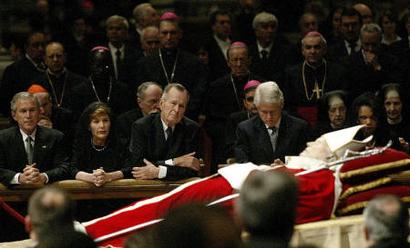
Who's looking the most devout here? The Holy Father, I'm sure, is grateful that the U.S. Delegation pays their respects. But let's recall how John Paul commented on Clinton when he visited as President: Clinton wouldn't look him in the eye, the Pope found him to be rude, looking at the frescoes instead of listening to our beloved Holy Father speak.

Up to 2 million Poles arrive in Rome for Pope John Paul II's funeral
VATICAN CITY (CNS) -- Up to 2 million Poles are believed to have reached Rome for the funeral of Pope John Paul II. "For today at least, this is our second Poland," said Maria Przytula, 60, a retired lawyer from the southern city of Wroclaw, who traveled with her son and grandson. "The Poles are united here -- it's an exceptional experience of joy and thanksgiving for all he did for us," she said. Przytula was one of thousands lined up along Rome's Via della Conciliazione to enter St. Peter's Square in a mass of red and white Polish flags. Mieczyslaw Kryminek, a worker from the shipyard in Gdansk, birthplace of Poland's Solidarity movement, said Poles were determined to reach Rome to pay homage to their "second father."
4.06.2005
John Paul II as a Pioneer of Woman's Human Rights
Amid accolades to our Holy Father, we hear the faint but nagging voices of those who now await a more "liberal" papacy. With a College of Cardinals hand picked by the him, we can be assured that the papacy will follow the path paved by the enlightenment and truth of John Paul.
What these nagging voices have not embraced, is the truth of our dignity as men and women. The Pope, coining the phrase "feminine genius", spoke directly to the unique and irreplaceable role of women in the Church and in the whole community.
I love the quote Helen Alvaré told us about from a meeting she was at with the Holy Father. He said, "Remember, I am the 'Feminist Pope!'" He tried to inculcate society to the dignity of woman, and not the "cheap equalization with man." John Paul encourages us, as women, to embrace our uniqueness as women, for true women's liberation is about "helping her to be herself."
What these nagging voices have not embraced, is the truth of our dignity as men and women. The Pope, coining the phrase "feminine genius", spoke directly to the unique and irreplaceable role of women in the Church and in the whole community.
I love the quote Helen Alvaré told us about from a meeting she was at with the Holy Father. He said, "Remember, I am the 'Feminist Pope!'" He tried to inculcate society to the dignity of woman, and not the "cheap equalization with man." John Paul encourages us, as women, to embrace our uniqueness as women, for true women's liberation is about "helping her to be herself."
4.05.2005
Pope appears with Blessed Mother to Medjugorje Seer
From Spirit Daily
A friend of ours close to Medjugorje seer Ivan Dragicevic of Bosnia-Hercegovina writes, "At Ivan's apparition tonight (4/2 in U.S.) Ivan was recommending intentions to Our Lady when the Pope appeared on her left. He was smiling, young and very happy. All in white with a long gold cape. Our Lady said to Ivan: 'this is my son; he is with me.' Personally, I have never seen Ivan so happy."
Vatican: John Paul II Was Not Embalmed
To those who are not familiar with some of the great saints whose bodies have remained virtually "untouched" by dust of the grave, embalming would seem like a gruesome or unpleasant subject.
But with our Beloved John Paul II, we await a first miracle that could herald the beatification and canonization cause. It is only a matter of time...
___________________________________________ MARTA FALCONI, Associated Press Writer
VATICAN CITY - Departing from tradition, Pope John Paul II was not embalmed, only "prepared" for viewing by hundreds of thousands of mourners, the Vatican said Tuesday.
Vatican spokesman Joaquin Navarro-Valls did not elaborate on the procedure, but an embalmer in Rome said it appeared John Paul's remains were only touched up with cosmetics.
Massimo Signoracci, whose family embalmed three other popes, said he could not be certain what had been done without examining the body.
Signoracci said even a light embalming is necessary for a body that is exposed for several days.
John Paul died on Saturday, and his remains were put on public view late Monday on an open platform in St. Peter's Basilica. He will be buried Friday.
Historically, organs were removed to make embalming more durable. Relics of 22 popes — from Sixtus V, who died in 1590, to Leo XIII, who died in 1903 — are kept in Rome's St. Anastasio and Vincent Church, near the Trevi fountain.
Pope Pius X, who reigned from 1903 to 1914, abolished the custom of removing organs.
Embalming usually consists of draining the blood and other bodily fluids and intravenously injecting formaldehyde and other preserving liquids.
Signoracci said his family had embalmed the remains of John XXIII in 1963, and of Paul VI and John Paul I, who both died in 1978.
Paul VI was only lightly embalmed before his body was placed before the public during Rome's hot summer. But after two days the skin and fingernails began losing their color.
John XXIII's body, by contrast, was in excellent condition when it was exhumed from the cramped grotto under the basilica in 2001 — 38 years after his death — and moved to the main floor following his beatification.
John Paul II, who expressed a will to be buried underground, will be placed in John XXIII's vacant tomb.
4.04.2005
'Be not afraid!'
When Pope John Paul II assumed the leadership of the Roman Catholic Church 26 years ago, he was not the familiar frail figure of recent years, burdened by disease and age. He was a vigorous man of 58, the youngest pope in 138 years and by far the most active. So much so that he was quickly dubbed "God's athlete," and was regularly seen jogging, swimming, even skiing.
The energetic style, perseverance and courage that became the hallmarks of John Paul's papacy were forged in the harsh experiences of his youth. When the Nazis shut down the university he was attending in his native Poland, he continued his studies in clandestine classes at night. When he turned to the priesthood, he was tutored in a secret, illegal seminary run by Krakow's archbishop. Later, when the communists tried to marginalize the church, he defiantly led open-air celebrations of the Mass and pushed ahead with new church construction.
In John Paul II, the first non-Italian pope in four centuries, the church got a startlingly blunt champion of the oppressed, a critic of war and a defender of the church's conservative orthodoxy. He leaves behind fundamental disputes on doctrinal matters from contraception to stem-cell research, but there is no disagreement that he reinvigorated the papacy with leadership that was inspiring and disciplined.
Between his election in 1978 and his death on Saturday, he left a unique imprint. More than any of his 263 predecessors, he broke out of the reclusive world of the Vatican and carried his message around the globe to Catholics and non-Catholics alike, exploiting the capabilities of modern transportation, high-tech communications and his own warm and earthy personality.
"Be not afraid!" John Paul repeated three times during his installation sermon. He practiced the fearlessness that he preached, in challenging communism, in admitting the errors of his church, in his recovery from a 1981 assassination attempt and, finally, in facing a long and debilitating illness.
John Paul's early support for Solidarity, the Polish workers' rights movement, gave confidence to oppressed millions across the Soviet empire that communism could be faced down and would eventually fall. A decade later, it did, crashing like the "rotten tree" John Paul said it was.
In a series of unprecedented and welcome moves, he reached out to other Christians and to other faiths. He was the first pope to preach in a Protestant church or a synagogue and the first to set foot inside of a mosque.
He was a consistent advocate for the poor and downtrodden, attacking not only the abuses of communism but also the excesses of capitalism. "I am the voice of the voiceless," he said, a voice needed in a world dotted with political and economic oppression.
And, in a move almost unheard of for an institution that rarely has acknowledged error, he apologized. He used the advent of the new millennium to issue a sweeping apology for sins and mistakes committed during the church's 2,000 years of at-times bloody existence, implicitly invoking the Crusades, the Inquisition, the Holocaust and Christianity's history of anti-Semitism. He later also apologized to those who have suffered sexual abuse by priests and for the excesses committed by Catholic missionaries.
During his tenure, he traveled to 129 countries and presided over open-air Masses that attracted hundreds of thousands of believers and the curious. A one-time actor and author of several plays, John Paul exploited his mastery of timing, humor and command of languages to communicate in a way that few other world figures have been able to do.
But his travels — particularly in North America and Western Europe — also put a spotlight on the resistance of millions of Catholics to his resolute defense of traditional doctrines as they impact contemporary social and political issues. Many liberals and moderates have ignored his teachings on abortion, contraception, homosexuality and women's issues. Conservatives have gone their own way on the death penalty, nuclear weapons, war and economic policies.
In the United States, solid majorities of Catholics surveyed in a USA TODAY/CNN/Gallup Poll on Friday and Saturday said the next pope should allow Catholics to use birth control, permit priests to be married, liberalize church doctrine on stem-cell research and let women become priests.
These fundamental disagreements with church doctrine, however, did not detract from their admiration for John Paul. Two-thirds of those surveyed called him "one of the greatest" popes. In a problem-plagued world, a leader who stands by his principles, popular or not, commands respect.
That grit and determination became all the more evident as John Paul became a bent and pained figure, weighed down by the ravages of arthritis and Parkinson's disease. He repeatedly brushed aside any suggestion he might have to step down, declaring he wanted to continue his mission "until the end."
That end came peacefully, in his apartment three stories above St. Peter's Square. History will eventually judge John Paul's role in the ongoing arguments within Catholicism over points of doctrine and administration of the church.
The verdict is already in, however, on his role as an unafraid champion of peace and humanity: God's athlete was a giant.
The energetic style, perseverance and courage that became the hallmarks of John Paul's papacy were forged in the harsh experiences of his youth. When the Nazis shut down the university he was attending in his native Poland, he continued his studies in clandestine classes at night. When he turned to the priesthood, he was tutored in a secret, illegal seminary run by Krakow's archbishop. Later, when the communists tried to marginalize the church, he defiantly led open-air celebrations of the Mass and pushed ahead with new church construction.
In John Paul II, the first non-Italian pope in four centuries, the church got a startlingly blunt champion of the oppressed, a critic of war and a defender of the church's conservative orthodoxy. He leaves behind fundamental disputes on doctrinal matters from contraception to stem-cell research, but there is no disagreement that he reinvigorated the papacy with leadership that was inspiring and disciplined.
Between his election in 1978 and his death on Saturday, he left a unique imprint. More than any of his 263 predecessors, he broke out of the reclusive world of the Vatican and carried his message around the globe to Catholics and non-Catholics alike, exploiting the capabilities of modern transportation, high-tech communications and his own warm and earthy personality.
"Be not afraid!" John Paul repeated three times during his installation sermon. He practiced the fearlessness that he preached, in challenging communism, in admitting the errors of his church, in his recovery from a 1981 assassination attempt and, finally, in facing a long and debilitating illness.
John Paul's early support for Solidarity, the Polish workers' rights movement, gave confidence to oppressed millions across the Soviet empire that communism could be faced down and would eventually fall. A decade later, it did, crashing like the "rotten tree" John Paul said it was.
In a series of unprecedented and welcome moves, he reached out to other Christians and to other faiths. He was the first pope to preach in a Protestant church or a synagogue and the first to set foot inside of a mosque.
He was a consistent advocate for the poor and downtrodden, attacking not only the abuses of communism but also the excesses of capitalism. "I am the voice of the voiceless," he said, a voice needed in a world dotted with political and economic oppression.
And, in a move almost unheard of for an institution that rarely has acknowledged error, he apologized. He used the advent of the new millennium to issue a sweeping apology for sins and mistakes committed during the church's 2,000 years of at-times bloody existence, implicitly invoking the Crusades, the Inquisition, the Holocaust and Christianity's history of anti-Semitism. He later also apologized to those who have suffered sexual abuse by priests and for the excesses committed by Catholic missionaries.
During his tenure, he traveled to 129 countries and presided over open-air Masses that attracted hundreds of thousands of believers and the curious. A one-time actor and author of several plays, John Paul exploited his mastery of timing, humor and command of languages to communicate in a way that few other world figures have been able to do.
But his travels — particularly in North America and Western Europe — also put a spotlight on the resistance of millions of Catholics to his resolute defense of traditional doctrines as they impact contemporary social and political issues. Many liberals and moderates have ignored his teachings on abortion, contraception, homosexuality and women's issues. Conservatives have gone their own way on the death penalty, nuclear weapons, war and economic policies.
In the United States, solid majorities of Catholics surveyed in a USA TODAY/CNN/Gallup Poll on Friday and Saturday said the next pope should allow Catholics to use birth control, permit priests to be married, liberalize church doctrine on stem-cell research and let women become priests.
These fundamental disagreements with church doctrine, however, did not detract from their admiration for John Paul. Two-thirds of those surveyed called him "one of the greatest" popes. In a problem-plagued world, a leader who stands by his principles, popular or not, commands respect.
That grit and determination became all the more evident as John Paul became a bent and pained figure, weighed down by the ravages of arthritis and Parkinson's disease. He repeatedly brushed aside any suggestion he might have to step down, declaring he wanted to continue his mission "until the end."
That end came peacefully, in his apartment three stories above St. Peter's Square. History will eventually judge John Paul's role in the ongoing arguments within Catholicism over points of doctrine and administration of the church.
The verdict is already in, however, on his role as an unafraid champion of peace and humanity: God's athlete was a giant.
Requiem for 'the Great'
By Daniel Williams
Washington Post Foreign Service
Monday, April 4, 2005; Page A01
VATICAN CITY, April 3 -- Pope John Paul II, who in life attracted millions of worshipers and admirers to gatherings around the world, in death received an immense homage Sunday from close to 150,000 pilgrims who gathered for an open-air Requiem in St. Peter's Square.
As soon as Cardinal Angelo Sodano, who presided at the Mass, mentioned the late pope's name, the sea of worshipers applauded loudly. In his written homily, Sodano referred to John Paul as "the Great," an honorific applied only to two of the church's 263 previous pontiffs. "He died with the serenity of the saints," Sodano, who had been the pontiff's secretary of state, told the crowd.
Inside a marble-covered hall, John Paul's body lay in state for viewing by cardinals and dignitaries. The ceremony was broadcast to the outside world for the first time in the history of the Roman Catholic Church.
The dual events provided an indication of what is fast becoming a mammoth pageant of grief and adulation, arguably without parallel in the church. Rome is preparing to host 2 million or more pilgrims for John Paul's funeral. Train stations and stadiums are being opened for campers. Hotels in the city are already reporting full occupancy. The pope's body will lie in state at St. Peter's Basilica for viewing by the public beginning Monday afternoon.
The personality of the next pontiff was a topic of growing discussion among cardinals who will convene within the next 19 days to choose John Paul's successor. Some of them said that someone like John Paul was needed.
Cardinal Philippe Barbarin, the archbishop of Lyon, described an ideal pope to French Inter radio: "When you see his face, and when you hear him speak, you should have the impression like that made by the arrival of John Paul II in October 1978 -- wow, here you can see Christ come among us," he said.
Cardinal Wilfred Napier of South Africa told the Associated Press that "my own view is that we need someone who has vision and can look into the future, like John Paul did."
"There's a big void," Cardinal Roger M. Mahony of Los Angeles told reporters outside St. Peter's Basilica.
In any event, a new dialogue was clearly underway. "It's legitimate to talk among ourselves now in a way it was not while John Paul was alive," said Cardinal James Stafford, an American who works in the Vatican.
In St. Peter's Square on Sunday, ardent Catholics mixed with religiously indifferent tourists. Italians mingled with migrant workers who waved flags of their home countries: India, Colombia, Albania, Romania and, in several parts of the square, Poland. Well-off worshipers wearing gold earrings prayed beside maids manipulating plastic rosaries.
Many mourners clutched pictures of John Paul. All seemed eager to praise him and see him bestowed with what is effectively Catholicism's highest honor: "The least they can do is make him a saint," said Antonella Rado, who drove to Rome overnight from southeastern Italy. "He will always be among us."
"He is a saint," embarked Roberto Baldi, a Rome policeman. "He brought people close to him, no matter who they were."
The morning after John Paul died in his Vatican apartment at age 84, officials issued the precise cause of death: septic shock, a medical term for a severe infection that causes organ failure, and collapse of the cardiovascular system.
Among the underlying causes for his swift decline was Parkinson's disease, the statement said. It was the first time the Vatican has acknowledged that the pope suffered from the disease that outside physicians estimate began to afflict him about 15 years ago
The pope also suffered acute breathing failure, low blood pressure, insufficient blood flow and an enlarged prostate gland. The death certificate said the urinary tract infection that poisoned his blood was a complication of the prostate problem.
The statement said that the Vatican's chamberlain, or camerlengo, Cardinal Eduardo Martinez Somalo, confirmed the pope's death, as required by church regulations. Martinez Somalo is the interim spiritual leader of the church, though he lacks governing authority.
In past eras, the chamberlain is said to have authenticated a pope's death by tapping his forehead three times with a silver hammer and calling out his given name. On Saturday, confirmation was by means of 20 minutes of monitoring with a special electrocardiograph.
The pope's body lay atop a bier Sunday in Clementine Hall, a reception room down the hall from the apartment where he died. John Paul was attired in red vestments. A white miter was set on his head, which rested on three golden damask pillows. The pope's familiar long silver pastoral staff was tucked under his left arm. Folded hands held a wooden rosary.
His face showed traces of a death agony. His cheeks were drawn, with deep creases.
Swiss Guards dressed in 16th-century orange-and-blue uniforms flanked the bier. Cardinals in white lace doffed scarlet skullcaps as they bowed and kneeled before the body.
Tears rimmed the eyes of Archbishop Stanislaw Dziwisz, the pope's private secretary and longtime friend. Dziwisz and other Polish clerics and nuns who made up John Paul's "household," as it was called, sat in pews to the pope's left.
Italian politicians, led by President Carlo Azeglio Ciampi, paid respects. Gregorian chants and prayers recited in Latin echoed through the room.
Somalo sprinkled the body with holy water. "We thank you, God, for the good things that you gave your church through him," he said. "O God of mercy, our Pope John Paul II received the light of faith while he lived on Earth. Now he is coming to you, his lamp lit."
In the square, Archbishop Leonardo Sandri, who was the pope's voice when he was unable to speak because of illness, delivered a prayer that Vatican officials said John Paul had been scheduled to deliver on this Sunday. "I do it with much honor and so much nostalgia," Sandri said before reading the prayer.
"To all humanity, which today seems so lost and dominated by the power of evil, selfishness and fear, our resurrected Lord gives us his love which forgives, reconciles and reopens the soul to hope," the message read.
Sodano, in his spoken remarks, did not describe John Paul as "the Great." The phrase was in the written text, however, and under Vatican rules, what is written is official. There was no explanation for the inconsistency.
The only other popes to be called "the Great" were Leo I, a 5th-century pontiff who warded off an attack on Rome by Attila the Hun, and Gregory I, who at the turn of the 7th century protected Rome against invading Lombards.
Sodano is already the subject of rumors of Vatican intrigue following a breach of protocol. Under church rules, the death should have been announced by the pope's assistant as bishop of Rome, Cardinal Camillo Ruini. But Sodano told Sandri to announce the news in St. Peter's Square, Vatican officials said. Ruini heard it on television. Ruini released his announcement Sunday, in writing. "We thank God for giving us a pastor who with his life and word has taken with untiring courage the path on which Christ guides men," it said.
Washington Post Foreign Service
Monday, April 4, 2005; Page A01
VATICAN CITY, April 3 -- Pope John Paul II, who in life attracted millions of worshipers and admirers to gatherings around the world, in death received an immense homage Sunday from close to 150,000 pilgrims who gathered for an open-air Requiem in St. Peter's Square.
As soon as Cardinal Angelo Sodano, who presided at the Mass, mentioned the late pope's name, the sea of worshipers applauded loudly. In his written homily, Sodano referred to John Paul as "the Great," an honorific applied only to two of the church's 263 previous pontiffs. "He died with the serenity of the saints," Sodano, who had been the pontiff's secretary of state, told the crowd.
Inside a marble-covered hall, John Paul's body lay in state for viewing by cardinals and dignitaries. The ceremony was broadcast to the outside world for the first time in the history of the Roman Catholic Church.
The dual events provided an indication of what is fast becoming a mammoth pageant of grief and adulation, arguably without parallel in the church. Rome is preparing to host 2 million or more pilgrims for John Paul's funeral. Train stations and stadiums are being opened for campers. Hotels in the city are already reporting full occupancy. The pope's body will lie in state at St. Peter's Basilica for viewing by the public beginning Monday afternoon.
The personality of the next pontiff was a topic of growing discussion among cardinals who will convene within the next 19 days to choose John Paul's successor. Some of them said that someone like John Paul was needed.
Cardinal Philippe Barbarin, the archbishop of Lyon, described an ideal pope to French Inter radio: "When you see his face, and when you hear him speak, you should have the impression like that made by the arrival of John Paul II in October 1978 -- wow, here you can see Christ come among us," he said.
Cardinal Wilfred Napier of South Africa told the Associated Press that "my own view is that we need someone who has vision and can look into the future, like John Paul did."
"There's a big void," Cardinal Roger M. Mahony of Los Angeles told reporters outside St. Peter's Basilica.
In any event, a new dialogue was clearly underway. "It's legitimate to talk among ourselves now in a way it was not while John Paul was alive," said Cardinal James Stafford, an American who works in the Vatican.
In St. Peter's Square on Sunday, ardent Catholics mixed with religiously indifferent tourists. Italians mingled with migrant workers who waved flags of their home countries: India, Colombia, Albania, Romania and, in several parts of the square, Poland. Well-off worshipers wearing gold earrings prayed beside maids manipulating plastic rosaries.
Many mourners clutched pictures of John Paul. All seemed eager to praise him and see him bestowed with what is effectively Catholicism's highest honor: "The least they can do is make him a saint," said Antonella Rado, who drove to Rome overnight from southeastern Italy. "He will always be among us."
"He is a saint," embarked Roberto Baldi, a Rome policeman. "He brought people close to him, no matter who they were."
The morning after John Paul died in his Vatican apartment at age 84, officials issued the precise cause of death: septic shock, a medical term for a severe infection that causes organ failure, and collapse of the cardiovascular system.
Among the underlying causes for his swift decline was Parkinson's disease, the statement said. It was the first time the Vatican has acknowledged that the pope suffered from the disease that outside physicians estimate began to afflict him about 15 years ago
The pope also suffered acute breathing failure, low blood pressure, insufficient blood flow and an enlarged prostate gland. The death certificate said the urinary tract infection that poisoned his blood was a complication of the prostate problem.
The statement said that the Vatican's chamberlain, or camerlengo, Cardinal Eduardo Martinez Somalo, confirmed the pope's death, as required by church regulations. Martinez Somalo is the interim spiritual leader of the church, though he lacks governing authority.
In past eras, the chamberlain is said to have authenticated a pope's death by tapping his forehead three times with a silver hammer and calling out his given name. On Saturday, confirmation was by means of 20 minutes of monitoring with a special electrocardiograph.
The pope's body lay atop a bier Sunday in Clementine Hall, a reception room down the hall from the apartment where he died. John Paul was attired in red vestments. A white miter was set on his head, which rested on three golden damask pillows. The pope's familiar long silver pastoral staff was tucked under his left arm. Folded hands held a wooden rosary.
His face showed traces of a death agony. His cheeks were drawn, with deep creases.
Swiss Guards dressed in 16th-century orange-and-blue uniforms flanked the bier. Cardinals in white lace doffed scarlet skullcaps as they bowed and kneeled before the body.
Tears rimmed the eyes of Archbishop Stanislaw Dziwisz, the pope's private secretary and longtime friend. Dziwisz and other Polish clerics and nuns who made up John Paul's "household," as it was called, sat in pews to the pope's left.
Italian politicians, led by President Carlo Azeglio Ciampi, paid respects. Gregorian chants and prayers recited in Latin echoed through the room.
Somalo sprinkled the body with holy water. "We thank you, God, for the good things that you gave your church through him," he said. "O God of mercy, our Pope John Paul II received the light of faith while he lived on Earth. Now he is coming to you, his lamp lit."
In the square, Archbishop Leonardo Sandri, who was the pope's voice when he was unable to speak because of illness, delivered a prayer that Vatican officials said John Paul had been scheduled to deliver on this Sunday. "I do it with much honor and so much nostalgia," Sandri said before reading the prayer.
"To all humanity, which today seems so lost and dominated by the power of evil, selfishness and fear, our resurrected Lord gives us his love which forgives, reconciles and reopens the soul to hope," the message read.
Sodano, in his spoken remarks, did not describe John Paul as "the Great." The phrase was in the written text, however, and under Vatican rules, what is written is official. There was no explanation for the inconsistency.
The only other popes to be called "the Great" were Leo I, a 5th-century pontiff who warded off an attack on Rome by Attila the Hun, and Gregory I, who at the turn of the 7th century protected Rome against invading Lombards.
Sodano is already the subject of rumors of Vatican intrigue following a breach of protocol. Under church rules, the death should have been announced by the pope's assistant as bishop of Rome, Cardinal Camillo Ruini. But Sodano told Sandri to announce the news in St. Peter's Square, Vatican officials said. Ruini heard it on television. Ruini released his announcement Sunday, in writing. "We thank God for giving us a pastor who with his life and word has taken with untiring courage the path on which Christ guides men," it said.
4.03.2005
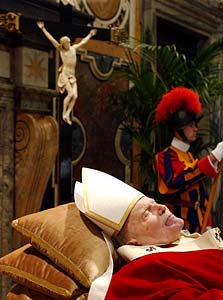
John Paul's Message for Divine Mercy Sunday
Pope Left a Message for Divine Mercy Sunday
Read by Archbishop Sandri in St. Peter's Square
VATICAN CITY, APRIL 3, 2005 (Zenit.org).- To the surprise of the faithful attending the Mass for John Paul II's eternal rest, a Vatican official read a message the Pope had prepared for Divine Mercy Sunday.
Archbishop Leonardo Sandri, substitute of the Vatican Secretariat of State, told the crowd of 130,000 in St. Peter's Square today that he read the text "with much honor and much nostalgia" -- and "by the explicit indication" of the Pope himself.
"To humanity, which at times seems to be lost and dominated by the power of evil, egoism and fear, the risen Lord offers as a gift his love that forgives, reconciles and reopens the spirit to hope," affirmed the Pope in his posthumous message.
"It is love that converts hearts and gives peace. How much need the world has to understand and accept Divine Mercy!" the Holy Father's message stated.
John Paul II proclaimed the feast of Divine Mercy for the universal Church when canonizing Polish nun and mystic Faustina Kowalska (1905-1938) on April 30, 2000.
In his message for the recitation of the Regina Caeli, the Holy Father wrote: "Lord, who with your death and resurrection reveal the love of the Father, we believe in you and with confidence repeat to you today: Jesus, I trust in you, have mercy on us and on the whole world."
John Paul II's Posthumous Message for Divine Mercy Sunday
"The Risen Lord Offers as a Gift His Love That Forgives"
Dear Brothers and Sisters!
1. The joyful Easter Alleluia resounds also today. Today's Gospel page of St. John underlines that the Risen One, on the night of that day, appeared to the Apostles and "showed them his hands and his side" (John 20:20), that is, the signs of the painful Passion printed indelibly on his body also after his Resurrection. Those glorious wounds, which eight days later he made the incredulous Thomas touch, reveal the mercy of God "for God so loved the world that he gave his only Son" (John 3:16).
This mystery of love is at the heart of today's liturgy, Sunday "in Albis," dedicated to the worship of Divine Mercy.
2. To humanity, which at times seems to be lost and dominated by the power of evil, egoism and fear, the risen Lord offers as a gift his love that forgives, reconciles and reopens the spirit to hope. It is love that converts hearts and gives peace. How much need the world has to understand and accept Divine Mercy!
Lord, who with [your] Death and Resurrection reveal the love of the Father, we believe in you and with confidence repeat to you today: Jesus, I trust in you, have mercy on us and on the whole world.
3. The liturgical solemnity of the Annunciation, which we celebrate tomorrow, leads us to contemplate with Mary's eyes the enormous mystery of this merciful love that arises from Christ's heart. With her help, we can understand the true meaning of paschal joy, which is based on this certainty: The One whom the Virgin carried in her womb, who suffered and died for us, has truly risen. Alleluia!
Read by Archbishop Sandri in St. Peter's Square
VATICAN CITY, APRIL 3, 2005 (Zenit.org).- To the surprise of the faithful attending the Mass for John Paul II's eternal rest, a Vatican official read a message the Pope had prepared for Divine Mercy Sunday.
Archbishop Leonardo Sandri, substitute of the Vatican Secretariat of State, told the crowd of 130,000 in St. Peter's Square today that he read the text "with much honor and much nostalgia" -- and "by the explicit indication" of the Pope himself.
"To humanity, which at times seems to be lost and dominated by the power of evil, egoism and fear, the risen Lord offers as a gift his love that forgives, reconciles and reopens the spirit to hope," affirmed the Pope in his posthumous message.
"It is love that converts hearts and gives peace. How much need the world has to understand and accept Divine Mercy!" the Holy Father's message stated.
John Paul II proclaimed the feast of Divine Mercy for the universal Church when canonizing Polish nun and mystic Faustina Kowalska (1905-1938) on April 30, 2000.
In his message for the recitation of the Regina Caeli, the Holy Father wrote: "Lord, who with your death and resurrection reveal the love of the Father, we believe in you and with confidence repeat to you today: Jesus, I trust in you, have mercy on us and on the whole world."
John Paul II's Posthumous Message for Divine Mercy Sunday
"The Risen Lord Offers as a Gift His Love That Forgives"
Dear Brothers and Sisters!
1. The joyful Easter Alleluia resounds also today. Today's Gospel page of St. John underlines that the Risen One, on the night of that day, appeared to the Apostles and "showed them his hands and his side" (John 20:20), that is, the signs of the painful Passion printed indelibly on his body also after his Resurrection. Those glorious wounds, which eight days later he made the incredulous Thomas touch, reveal the mercy of God "for God so loved the world that he gave his only Son" (John 3:16).
This mystery of love is at the heart of today's liturgy, Sunday "in Albis," dedicated to the worship of Divine Mercy.
2. To humanity, which at times seems to be lost and dominated by the power of evil, egoism and fear, the risen Lord offers as a gift his love that forgives, reconciles and reopens the spirit to hope. It is love that converts hearts and gives peace. How much need the world has to understand and accept Divine Mercy!
Lord, who with [your] Death and Resurrection reveal the love of the Father, we believe in you and with confidence repeat to you today: Jesus, I trust in you, have mercy on us and on the whole world.
3. The liturgical solemnity of the Annunciation, which we celebrate tomorrow, leads us to contemplate with Mary's eyes the enormous mystery of this merciful love that arises from Christ's heart. With her help, we can understand the true meaning of paschal joy, which is based on this certainty: The One whom the Virgin carried in her womb, who suffered and died for us, has truly risen. Alleluia!
Who's in Charge Now?
With the death of the pope, the tasks of organizing a papal election and overseeing the day-to-day needs of the church fall to Cardinal Eduardo Martinez Somalo.
The 78-year-old Spaniard has been "camerlengo" or chamberlain of the Holy Roman Church since 1993, although the job was basically just a title while Pope John Paul II was alive.
Now Cardinal Martinez's responsibilities range from ensuring that nothing is touched or tampered with in the papal apartments to selecting the technicians who will sweep the Sistine Chapel for electronic bugs, cameras and recording devices.
As chamberlain, Cardinal Martinez is the only person who may authorize the photographing of the pope's dead body, but only for documentary purposes and with the body dressed in pontifical vestments.
In the Vatican's employ since 1956, Cardinal Martinez worked under five popes. In February 2004 he retired as prefect of the Congregation for Institutes of Consecrated Life and Societies of Apostolic Life.
From 1979 until his appointment to the College of Cardinals in 1988, he was one of Pope John Paul's closest aides, serving as "sostituto," or assistant, secretary of state.
As chamberlain he took temporary charge of the church's affairs until a new pope is elected. His first duty was to certify the death of the pope.
According to rules set by Pope John Paul in 1996, Cardinal Martinez was to seal the pope's study and bedroom and take possession of the Apostolic Palace and papal palaces at St. John Lateran in Rome and at Castel Gandolfo, south of the city.
In consultation with senior cardinals, he makes the arrangements for the pope's funeral and sets the date for the beginning of the meetings necessary to prepare for the conclave.
The chamberlain -- together with Cardinal Angelo Sodano, Pope John Paul's secretary of state, and U.S. Cardinal Edmund C. Szoka, governor of Vatican City State -- is responsible for preparing the cardinals' rooms in the Vatican's Domus Sanctae Marthae guest house.
While the office of pope is vacant, the chamberlain presides over what are called "particular congregations of the cardinals." In addition to the chamberlain, the particular congregations include three cardinals chosen by lot. The chamberlain's assistants serve for three days, then are replaced by three other cardinals chosen by lot.
The group of four deals with "ordinary affairs" not requiring the discussion and consent of the entire College of Cardinals, which meets under the presidency of the college's dean, Cardinal Joseph Ratzinger.
The particular congregation is the only body empowered to decide whether a reason exists for anyone in the conclave to communicate with anyone outside the gathering.
Cardinal Martinez and his three cardinal assistants also are responsible for giving approval to the individuals chosen to serve as priest-confessors, doctors and domestic staff for the cardinals in the conclave.
The chamberlain, with two masters of ceremonies, is responsible for administering an oath of secrecy to the non-cardinals whose service is needed by the conclave.
Under Pope John Paul's 1996 rules, Cardinal Martinez is required to write up a report on the results of each ballot, place it in a sealed envelope and give it to the new pope after he is elected.
If after about 30 ballots, one papal candidate has not received two-thirds of the votes, the chamberlain presides over the discussion of whether or not the cardinals want to move to a simple majority vote.
Although his role in the preparation and work of the conclave is key, the chamberlain's duties end inside the Sistine Chapel with the election of a new pope.
The 78-year-old Spaniard has been "camerlengo" or chamberlain of the Holy Roman Church since 1993, although the job was basically just a title while Pope John Paul II was alive.
Now Cardinal Martinez's responsibilities range from ensuring that nothing is touched or tampered with in the papal apartments to selecting the technicians who will sweep the Sistine Chapel for electronic bugs, cameras and recording devices.
As chamberlain, Cardinal Martinez is the only person who may authorize the photographing of the pope's dead body, but only for documentary purposes and with the body dressed in pontifical vestments.
In the Vatican's employ since 1956, Cardinal Martinez worked under five popes. In February 2004 he retired as prefect of the Congregation for Institutes of Consecrated Life and Societies of Apostolic Life.
From 1979 until his appointment to the College of Cardinals in 1988, he was one of Pope John Paul's closest aides, serving as "sostituto," or assistant, secretary of state.
As chamberlain he took temporary charge of the church's affairs until a new pope is elected. His first duty was to certify the death of the pope.
According to rules set by Pope John Paul in 1996, Cardinal Martinez was to seal the pope's study and bedroom and take possession of the Apostolic Palace and papal palaces at St. John Lateran in Rome and at Castel Gandolfo, south of the city.
In consultation with senior cardinals, he makes the arrangements for the pope's funeral and sets the date for the beginning of the meetings necessary to prepare for the conclave.
The chamberlain -- together with Cardinal Angelo Sodano, Pope John Paul's secretary of state, and U.S. Cardinal Edmund C. Szoka, governor of Vatican City State -- is responsible for preparing the cardinals' rooms in the Vatican's Domus Sanctae Marthae guest house.
While the office of pope is vacant, the chamberlain presides over what are called "particular congregations of the cardinals." In addition to the chamberlain, the particular congregations include three cardinals chosen by lot. The chamberlain's assistants serve for three days, then are replaced by three other cardinals chosen by lot.
The group of four deals with "ordinary affairs" not requiring the discussion and consent of the entire College of Cardinals, which meets under the presidency of the college's dean, Cardinal Joseph Ratzinger.
The particular congregation is the only body empowered to decide whether a reason exists for anyone in the conclave to communicate with anyone outside the gathering.
Cardinal Martinez and his three cardinal assistants also are responsible for giving approval to the individuals chosen to serve as priest-confessors, doctors and domestic staff for the cardinals in the conclave.
The chamberlain, with two masters of ceremonies, is responsible for administering an oath of secrecy to the non-cardinals whose service is needed by the conclave.
Under Pope John Paul's 1996 rules, Cardinal Martinez is required to write up a report on the results of each ballot, place it in a sealed envelope and give it to the new pope after he is elected.
If after about 30 ballots, one papal candidate has not received two-thirds of the votes, the chamberlain presides over the discussion of whether or not the cardinals want to move to a simple majority vote.
Although his role in the preparation and work of the conclave is key, the chamberlain's duties end inside the Sistine Chapel with the election of a new pope.
Following the Pope's Instructions
By Cindy Wooden
Catholic News Service
VATICAN CITY (CNS) -- When he announced Pope John Paul II's death April 2, Vatican spokesman Joaquin Navarro-Valls added that Vatican officials were following all of the procedures called for in rules written by the pope in 1996.
The rules are contained in the apostolic constitution "Universi Dominici Gregis" ("The Shepherd of the Lord's Whole Flock").
When Pope John Paul died, those at his beside included his longtime secretary, Archbishop Stanislaw Dziwisz, and two old friends: Cardinal Marian Jaworski, the Latin-rite archbishop of Lviv, Ukraine; and Father Tadeusz Styczen, a former student of the pope's, now a professor in Poland.
Following the rules outlined by the pope, those with the pope when he died informed the camerlengo, or chamberlain of the Holy Roman Church, Spanish Cardinal Eduardo Martinez Somalo, who officially verifies the pope's death. He places seals on the pope's study and bedroom. The pope's personal secretaries and the nuns who work in the papal apartments are permitted to stay until after his funeral, at which time the entire apartment is sealed.
Navarro-Valls said immediately after the pope died several others arrived: Cardinal Angelo Sodano, Vatican secretary of state; Archbishop Leonardo Sandri, assistant secretary of state; and Archbishop Paolo Sardi, the vice chamberlain.
Other procedures called for in the apostolic constitution include:
-- The chamberlain notifies the papal vicar for Rome, Cardinal Camillo Ruini, who informs the city's citizens.
-- The chamberlain or the prefect of the papal household, U.S. Archbishop James Harvey, is charged with informing the dean of the College of Cardinals, Cardinal Joseph Ratzinger. The dean calls the other cardinals to Rome and informs ambassadors accredited to the Vatican of the pope's death.
-- The chamberlain also calls a meeting of three cardinals to plan the pope's funeral and burial, unless the pope has left specific instructions. The three cardinals are the senior members of each of the three "orders" of cardinals: cardinal bishops, cardinal priests and cardinal deacons.
About three hours after the pope's death, Navarro-Valls announced that the pope's body is expected to be taken to St. Peter's Basilica "no earlier" than the afternoon of April 4 for public viewing and prayer.
The first general congregation of cardinals to discuss the pope's funeral and the mourning period and to begin planning for the conclave to elect his successor was scheduled for the morning of April 4 in the Apostolic Palace, Navarro-Valls said.
Catholic News Service
VATICAN CITY (CNS) -- When he announced Pope John Paul II's death April 2, Vatican spokesman Joaquin Navarro-Valls added that Vatican officials were following all of the procedures called for in rules written by the pope in 1996.
The rules are contained in the apostolic constitution "Universi Dominici Gregis" ("The Shepherd of the Lord's Whole Flock").
When Pope John Paul died, those at his beside included his longtime secretary, Archbishop Stanislaw Dziwisz, and two old friends: Cardinal Marian Jaworski, the Latin-rite archbishop of Lviv, Ukraine; and Father Tadeusz Styczen, a former student of the pope's, now a professor in Poland.
Following the rules outlined by the pope, those with the pope when he died informed the camerlengo, or chamberlain of the Holy Roman Church, Spanish Cardinal Eduardo Martinez Somalo, who officially verifies the pope's death. He places seals on the pope's study and bedroom. The pope's personal secretaries and the nuns who work in the papal apartments are permitted to stay until after his funeral, at which time the entire apartment is sealed.
Navarro-Valls said immediately after the pope died several others arrived: Cardinal Angelo Sodano, Vatican secretary of state; Archbishop Leonardo Sandri, assistant secretary of state; and Archbishop Paolo Sardi, the vice chamberlain.
Other procedures called for in the apostolic constitution include:
-- The chamberlain notifies the papal vicar for Rome, Cardinal Camillo Ruini, who informs the city's citizens.
-- The chamberlain or the prefect of the papal household, U.S. Archbishop James Harvey, is charged with informing the dean of the College of Cardinals, Cardinal Joseph Ratzinger. The dean calls the other cardinals to Rome and informs ambassadors accredited to the Vatican of the pope's death.
-- The chamberlain also calls a meeting of three cardinals to plan the pope's funeral and burial, unless the pope has left specific instructions. The three cardinals are the senior members of each of the three "orders" of cardinals: cardinal bishops, cardinal priests and cardinal deacons.
About three hours after the pope's death, Navarro-Valls announced that the pope's body is expected to be taken to St. Peter's Basilica "no earlier" than the afternoon of April 4 for public viewing and prayer.
The first general congregation of cardinals to discuss the pope's funeral and the mourning period and to begin planning for the conclave to elect his successor was scheduled for the morning of April 4 in the Apostolic Palace, Navarro-Valls said.
The Pope's Last Mass, Feast of the Divine Mercy
VATICAN CITY, Vatican, April 2 (CNA) - Pope John Paul died after attending the Mass of the Divine Mercy, a feast he personally established three years ago, revealed the Vatican in a press release.
The Holy Father died at 9:37 p.m. in his private apartment.
“At 8 p.m., Vatican spokesman Joaquin Navarro-Valls explained “the celebration of Mass for Divine Mercy Sunday began in the Holy Father's room, presided by Archbishop Stanislaw Dziwisz with the participation of Cardinal Marian Jaworski, of Archbishop Stanislaw Rylko and of Msgr. Mieczyslaw Mokrzycki.”
During the Mass, the Holy Father received Holy Communion and the Anointing of the Sick.
“The Holy Father's final hours were marked by the uninterrupted prayer of all those who were assisting him in his pious death, and by the choral participation in prayer of the thousands of faithful who, for many hours, had been gathered in St. Peter's Square,” said the Vatican statement.
Present at the moment of the death of John Paul II were his two personal secretaries, Archbishop Stanislaw Dziwisz and Msgr. Mieczyslaw Mokrzycki, Cardinal Marian Jaworski, Archbishop Stanislaw Rylko, Fr. Tadeusz Styczen, the three nuns, Handmaidens of the Sacred Heart of Jesus, who assist in the Holy Father's apartment, and the Pope's personal physician Dr. Renato Buzzonetti, with the two doctors on call, Dr. Alessandro Barelli and Dr. Ciro D'Allo, and the two nurses on call.
According to Navarro-Valls, “immediately afterwards Cardinal Secretary of State Angelo Sodano arrived, as did the Chamberlain of the Holy Roman Church, Cardinal Eduardo Martinez Somalo, Archbishop Leonardo Sandri, substitute of the Secretariat of State, and Archbishop Paolo Sardi, Vice-Chamberlain of Holy Roman Church.
“Thereafter, Cardinal Joseph Ratzinger, dean of the College of Cardinals, and Cardinal Jozef Tomko also arrived”.
As the end of his life approached, the Holy Father reportedly dictated a message for the Catholic faithful to his secretary: "I am happy and you should be happy too. Do not weep. Let us pray together with joy."
Father Jarek Cielecki, director of a Vatican TV station, gave more of the details of the Holy Father's last moments: "The Holy Father died looking towards the window as he prayed, and that shows that in some way he was conscious," Cielecki said. "A short while before dying, the Pope raised his right hand in a clear, although simply hinted at, gesture of blessing, as if he became aware of the crowd of faithful present in St Peter's Square, who in those moments were following the reciting of the Rosary," he added. "Just after the prayer ended, the Pope made a huge effort and pronounced the word 'Amen'. A moment later, he died."
The Holy Father died at 9:37 p.m. in his private apartment.
“At 8 p.m., Vatican spokesman Joaquin Navarro-Valls explained “the celebration of Mass for Divine Mercy Sunday began in the Holy Father's room, presided by Archbishop Stanislaw Dziwisz with the participation of Cardinal Marian Jaworski, of Archbishop Stanislaw Rylko and of Msgr. Mieczyslaw Mokrzycki.”
During the Mass, the Holy Father received Holy Communion and the Anointing of the Sick.
“The Holy Father's final hours were marked by the uninterrupted prayer of all those who were assisting him in his pious death, and by the choral participation in prayer of the thousands of faithful who, for many hours, had been gathered in St. Peter's Square,” said the Vatican statement.
Present at the moment of the death of John Paul II were his two personal secretaries, Archbishop Stanislaw Dziwisz and Msgr. Mieczyslaw Mokrzycki, Cardinal Marian Jaworski, Archbishop Stanislaw Rylko, Fr. Tadeusz Styczen, the three nuns, Handmaidens of the Sacred Heart of Jesus, who assist in the Holy Father's apartment, and the Pope's personal physician Dr. Renato Buzzonetti, with the two doctors on call, Dr. Alessandro Barelli and Dr. Ciro D'Allo, and the two nurses on call.
According to Navarro-Valls, “immediately afterwards Cardinal Secretary of State Angelo Sodano arrived, as did the Chamberlain of the Holy Roman Church, Cardinal Eduardo Martinez Somalo, Archbishop Leonardo Sandri, substitute of the Secretariat of State, and Archbishop Paolo Sardi, Vice-Chamberlain of Holy Roman Church.
“Thereafter, Cardinal Joseph Ratzinger, dean of the College of Cardinals, and Cardinal Jozef Tomko also arrived”.
As the end of his life approached, the Holy Father reportedly dictated a message for the Catholic faithful to his secretary: "I am happy and you should be happy too. Do not weep. Let us pray together with joy."
Father Jarek Cielecki, director of a Vatican TV station, gave more of the details of the Holy Father's last moments: "The Holy Father died looking towards the window as he prayed, and that shows that in some way he was conscious," Cielecki said. "A short while before dying, the Pope raised his right hand in a clear, although simply hinted at, gesture of blessing, as if he became aware of the crowd of faithful present in St Peter's Square, who in those moments were following the reciting of the Rosary," he added. "Just after the prayer ended, the Pope made a huge effort and pronounced the word 'Amen'. A moment later, he died."
4.02.2005
“I am happy, be it yourselves as well.”
VATICAN CITY - John Paul II, who led the Roman Catholic Church for 26 years and helped topple communism in Europe while becoming the most-traveled pope, died Saturday night in his Vatican apartment after a long public struggle against debilitating illness. He was 84.
"We all feel like orphans this evening," Undersecretary of State Archbishop Leonardo Sandri told the crowd of 70,000 that had gathered in St. Peter's Square below the pope's still-lighted apartment windows.
The assembled faithful fell into a stunned silence before some people broke out in applause — an Italian tradition in which mourners often clap for important figures. Others wept.
The crowd, which appeared to grow quickly, recited the rosary. A person in the front held a Polish flag in honor of the Polish-born pontiff.
Prelates asked those in the square to keep silent so they might "accompany the pope in his first steps into heaven."
Later, as bells tolled in mourning, a group of young people sang, "Alleluia, he will rise again," while one of them strummed a guitar.
"The angels welcome you," Vatican TV said after papal spokesman Joaquin Navarro-Valls announced the death of the pope, who had for years suffered from Parkinson's disease and came down with fever and infections in recent weeks.
In contrast to the church's ancient traditions, Navarro-Valls announced the death in an e-mail to journalists: "The Holy Father died this evening at 9:37 p.m. (2:37 p.m. EST) in his private apartment." The spokesman said church officials were following instructions that John Paul had written for them on Feb. 22, 1996.
"He was a marvelous man. Now he's no longer suffering," Concetta Sposato, a pilgrim who heard the pope had died as she was on her way to St. Peter's to pray, said tearfully.
"I'm Polish. For us, he was a father," said pilgrim Beata Sowa.
Italy's ANSA news agency said Vatican and Italian flags were being lowered to half-staff across Rome and elsewhere. In Washington, flags over the White House also were lowered to half-staff.
People in John Paul II's hometown in Poland fell to their knees and wept as the news of his death reached them at the end of a special Mass in the church where he worshipped as a boy.
Church bells rang out after the announcement from the Vatican, but it took several minutes for people inside the packed, standing-room only church to find out as they continued their vigil into a second night.
Then parish priest, the Rev. Jakub Gil, came to the front of the church as the last hymn died away. "His life has come to an end. Our great countryman has died," he said. People inside the church and standing outside fell to their knees.
One of the pope's closest aides, Cardinal Joseph Ratzinger, was quoted Saturday as saying that when he saw the pontiff on Friday morning, John Paul was "aware that he is passing to the Lord."
The pope "gave me the final farewell," the news agency of the Italian bishops conference quoted the German cardinal as saying Friday night.
Pope John Paul II, before entering into the state of diminished consciousness, whispered to his personal secretary the eloquent phrase: “I am happy, be it yourselves as well.”
According to the Saturday issue of the Italian daily Il Secolo XIX, the Pope pronounced these moving words to Archbishop Stanislaw Dziwisz, his personal secretary and right hand from his days as Archbishop of Krakow (Poland.)
The message was mainly addressed to the priests and religious who have been serving the Pontiff in the last months.
Nevertheless, the phrase, according to the Italian daily, has become a “testament” for all the faithful around the world.
"We all feel like orphans this evening," Undersecretary of State Archbishop Leonardo Sandri told the crowd of 70,000 that had gathered in St. Peter's Square below the pope's still-lighted apartment windows.
The assembled faithful fell into a stunned silence before some people broke out in applause — an Italian tradition in which mourners often clap for important figures. Others wept.
The crowd, which appeared to grow quickly, recited the rosary. A person in the front held a Polish flag in honor of the Polish-born pontiff.
Prelates asked those in the square to keep silent so they might "accompany the pope in his first steps into heaven."
Later, as bells tolled in mourning, a group of young people sang, "Alleluia, he will rise again," while one of them strummed a guitar.
"The angels welcome you," Vatican TV said after papal spokesman Joaquin Navarro-Valls announced the death of the pope, who had for years suffered from Parkinson's disease and came down with fever and infections in recent weeks.
In contrast to the church's ancient traditions, Navarro-Valls announced the death in an e-mail to journalists: "The Holy Father died this evening at 9:37 p.m. (2:37 p.m. EST) in his private apartment." The spokesman said church officials were following instructions that John Paul had written for them on Feb. 22, 1996.
"He was a marvelous man. Now he's no longer suffering," Concetta Sposato, a pilgrim who heard the pope had died as she was on her way to St. Peter's to pray, said tearfully.
"I'm Polish. For us, he was a father," said pilgrim Beata Sowa.
Italy's ANSA news agency said Vatican and Italian flags were being lowered to half-staff across Rome and elsewhere. In Washington, flags over the White House also were lowered to half-staff.
People in John Paul II's hometown in Poland fell to their knees and wept as the news of his death reached them at the end of a special Mass in the church where he worshipped as a boy.
Church bells rang out after the announcement from the Vatican, but it took several minutes for people inside the packed, standing-room only church to find out as they continued their vigil into a second night.
Then parish priest, the Rev. Jakub Gil, came to the front of the church as the last hymn died away. "His life has come to an end. Our great countryman has died," he said. People inside the church and standing outside fell to their knees.
One of the pope's closest aides, Cardinal Joseph Ratzinger, was quoted Saturday as saying that when he saw the pontiff on Friday morning, John Paul was "aware that he is passing to the Lord."
The pope "gave me the final farewell," the news agency of the Italian bishops conference quoted the German cardinal as saying Friday night.
Pope John Paul II, before entering into the state of diminished consciousness, whispered to his personal secretary the eloquent phrase: “I am happy, be it yourselves as well.”
According to the Saturday issue of the Italian daily Il Secolo XIX, the Pope pronounced these moving words to Archbishop Stanislaw Dziwisz, his personal secretary and right hand from his days as Archbishop of Krakow (Poland.)
The message was mainly addressed to the priests and religious who have been serving the Pontiff in the last months.
Nevertheless, the phrase, according to the Italian daily, has become a “testament” for all the faithful around the world.
Pope addresses the youth from his bed
Pope clinging to life, slipping
Apr. 02 (CWNews.com) - Pope John Paul II (bio - news) continued to cling to life on April 2, although his spokesman said that his condition remained "very grave," and reported that the Holy Father had begun to lose consciousness early Saturday morning.
Joaquin Navarro-Valls, the director of the Vatican press office, told reporters that Mass had been celebrated in the Pope's apartment early in the morning. At that time, he said, John Paul II seemed aware of his surroundings, and opened his eyes when someone addressed him, but otherwise "seems to be sleeping." The Pope was not in a coma, he stressed, but his consciousness was "compromised" as his health failed.
During the night, Navarro-Valls said, the Pope had said several times, "I have looked for you. Now you have come to me. And I thank you." The papal spokesman interpreted those words as a message to the young people who were gathered in a prayer vigil in St. Peter's Square.
During the night, the square outside the papal apartment took on aspects of a World Youth Day celebration, with hundreds of young people praying and singing quiet hymns throughout the night, many of them holding candles, looking frequently up toward the windows of the Holy Father's apartment on the third floor, where the lights remained on. The windows of the Secretary of State, Cardinal Angelo Sodano (bio - news), also remained illumined until very late at night.
Journalists also kept vigil at the Vatican, with many reporters choosing to sleep in the floor of the Vatican press office, at the entry to St. Peter's Square. Meanwhile technicians began work at the Vatican installing the equipment that will be need to accommodate the College of Cardinals and the many thousands of people who are expected to gather for the Pope's funeral.
The Pope was attended during the night by his personal physician, Dr. Renato Buzzonetti, and other medical personnel. This longtime priest-secretary, Archbishop Stanislaw Dziwisz, was at his side throughout the Pope's latest ordeal.
Apr. 02 (CWNews.com) - Pope John Paul II (bio - news) continued to cling to life on April 2, although his spokesman said that his condition remained "very grave," and reported that the Holy Father had begun to lose consciousness early Saturday morning.
Joaquin Navarro-Valls, the director of the Vatican press office, told reporters that Mass had been celebrated in the Pope's apartment early in the morning. At that time, he said, John Paul II seemed aware of his surroundings, and opened his eyes when someone addressed him, but otherwise "seems to be sleeping." The Pope was not in a coma, he stressed, but his consciousness was "compromised" as his health failed.
During the night, Navarro-Valls said, the Pope had said several times, "I have looked for you. Now you have come to me. And I thank you." The papal spokesman interpreted those words as a message to the young people who were gathered in a prayer vigil in St. Peter's Square.
During the night, the square outside the papal apartment took on aspects of a World Youth Day celebration, with hundreds of young people praying and singing quiet hymns throughout the night, many of them holding candles, looking frequently up toward the windows of the Holy Father's apartment on the third floor, where the lights remained on. The windows of the Secretary of State, Cardinal Angelo Sodano (bio - news), also remained illumined until very late at night.
Journalists also kept vigil at the Vatican, with many reporters choosing to sleep in the floor of the Vatican press office, at the entry to St. Peter's Square. Meanwhile technicians began work at the Vatican installing the equipment that will be need to accommodate the College of Cardinals and the many thousands of people who are expected to gather for the Pope's funeral.
The Pope was attended during the night by his personal physician, Dr. Renato Buzzonetti, and other medical personnel. This longtime priest-secretary, Archbishop Stanislaw Dziwisz, was at his side throughout the Pope's latest ordeal.
4.01.2005
Pope prays Way of the Cross in his suffering
VATICAN CITY, Vatican, April 1 (CNA) - During the press conference this morning on the state of Pope John Paul II's health, Vatican spokesman Joaquin Navarro-Valls revealed the Pontiff requested a meditation on the Way of the Cross.
"The Pope has always been conscious," Navarro-Valls said. "Around 7:15am, remembering that today is Friday, the day on which ever since he was a young priest he has prayed the Way of the Cross, the Holy Father requested the 14 stations be prayed. He followed the prayers attentively. He made the sign of the cross during each of the stations."
Shortly after finishing the Way of the Cross," Navarro-Valls continued, "he asked to pray the Liturgy of the Hours."
He also said the Pope received visits from several of his collaborators.
"The Pope has always been conscious," Navarro-Valls said. "Around 7:15am, remembering that today is Friday, the day on which ever since he was a young priest he has prayed the Way of the Cross, the Holy Father requested the 14 stations be prayed. He followed the prayers attentively. He made the sign of the cross during each of the stations."
Shortly after finishing the Way of the Cross," Navarro-Valls continued, "he asked to pray the Liturgy of the Hours."
He also said the Pope received visits from several of his collaborators.
Pope in critical condition after heart failure
Vatican, Apr. 01 (CWNews.com) - Pope John Paul II (bio - news) suffered heart failure on Thursday while under treatment for a urinary infection which caused a high fever. On April 1 his condition had been stabilized, and papal spokesman Joaquin Navarro-Valls said that the Holy Father was "lucid, fully conscious, and extraordinarily serene," but conceded that his condition is "very grave."
Navarro-Valls was highly emotional, his eyes brimming with tears, as he briefed reporters on the Pope's condition at midday on Friday. He said that the Pope's overall condition had improved after a Thursday-night crisis, but his blood pressure remained "unstable" and his prognosis was poor. However, he flatly denied reports that the Pontiff had lapsed into a coma.
The Pope met with several top Vatican aides-- including the Secretary of State, Cardinal Angelo Sodano (bio - news), and the prefect of the Congregation for the Doctrine of the Faith, Cardinal Joseph Ratzinger (bio - news)-- on Friday morning. Aides reported that the Pontiff had asked them to read to him from the Stations of the Cross, which he followed attentively. The Pope also prayed the Liturgy of the Hours with his aides, and concelebrated Mass.
Navarro-Valls said that the Pope had expressed his preference to remain at the Vatican, receiving care from a medical team in his own apartment rather than returning to the Gemelli Hospital.
Pope John Paul received the Anointing of the Sick on Thursday, and roads to the Vatican were closed, as the faithful gathered in St. Peter's Square to pray for the Holy Father. Doctors observe that heart failure-- as distinct from a heart attack-- is usually a system of an irreparable physical breakdown.
Cardinal Camillo Ruini, the Pope's vicar for the Rome diocese-- and the prelate who would probably have the responsibility of making the formal public announcement of the Pope's death-- issued a statement asking the faithful to pray more intensively for John Paul II as he faces what appears to be his final struggle.
Navarro-Valls was highly emotional, his eyes brimming with tears, as he briefed reporters on the Pope's condition at midday on Friday. He said that the Pope's overall condition had improved after a Thursday-night crisis, but his blood pressure remained "unstable" and his prognosis was poor. However, he flatly denied reports that the Pontiff had lapsed into a coma.
The Pope met with several top Vatican aides-- including the Secretary of State, Cardinal Angelo Sodano (bio - news), and the prefect of the Congregation for the Doctrine of the Faith, Cardinal Joseph Ratzinger (bio - news)-- on Friday morning. Aides reported that the Pontiff had asked them to read to him from the Stations of the Cross, which he followed attentively. The Pope also prayed the Liturgy of the Hours with his aides, and concelebrated Mass.
Navarro-Valls said that the Pope had expressed his preference to remain at the Vatican, receiving care from a medical team in his own apartment rather than returning to the Gemelli Hospital.
Pope John Paul received the Anointing of the Sick on Thursday, and roads to the Vatican were closed, as the faithful gathered in St. Peter's Square to pray for the Holy Father. Doctors observe that heart failure-- as distinct from a heart attack-- is usually a system of an irreparable physical breakdown.
Cardinal Camillo Ruini, the Pope's vicar for the Rome diocese-- and the prelate who would probably have the responsibility of making the formal public announcement of the Pope's death-- issued a statement asking the faithful to pray more intensively for John Paul II as he faces what appears to be his final struggle.
Subscribe to:
Posts (Atom)